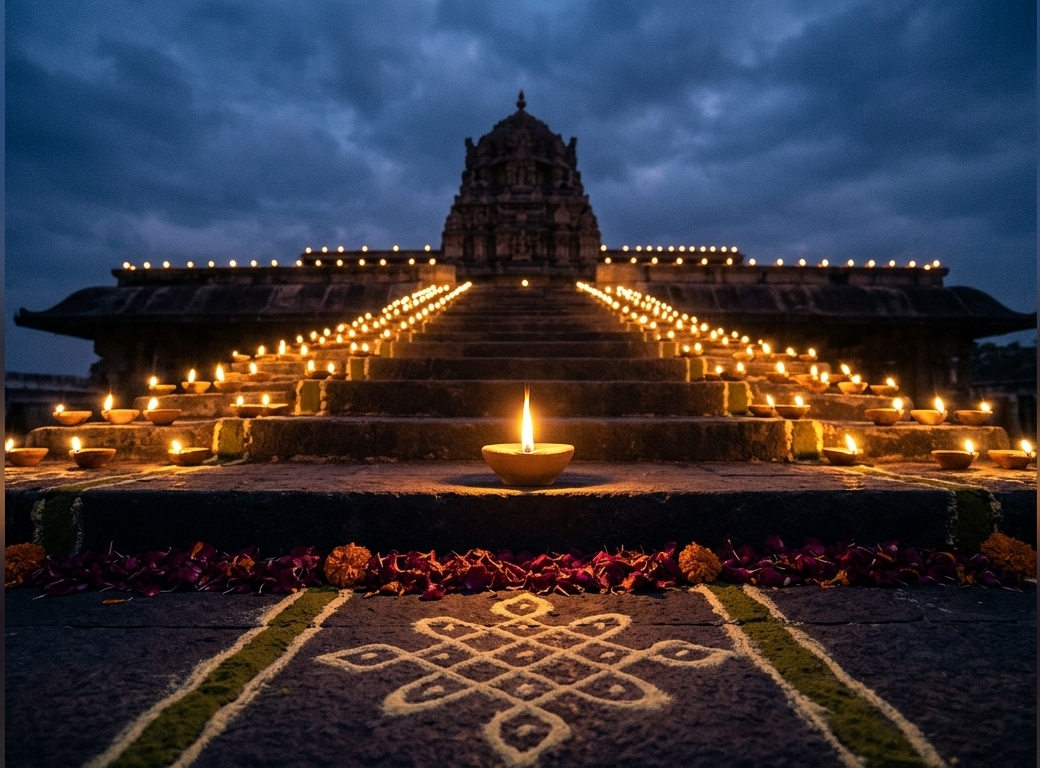
Diwali is celebrated today, Sunday, 8 November 2026, by well over a billion people across Hinduism, Jainism, Sikhism and Buddhism. The word comes from the Sanskrit dipavali, "a row of lights." But Diwali is not one story. It is several, woven together, and every strand says the same thing: darkness is real, and so is the choice to light a lamp anyway.
The Legends Behind the Lights
Rama returns to Ayodhya. After fourteen years of exile and the defeat of Ravana, Rama came home with Sita and Lakshmana on a moonless night. The people of Ayodhya lit the whole city with clay lamps so he could find his way. Every diya since is an echo of that welcome.
Krishna and Narakasura. In South India, Goa and western India, the festival remembers Krishna and Satyabhama defeating the tyrant Narakasura and freeing sixteen thousand captives. Dying, Narakasura asked that his death be celebrated, not mourned. This is why Naraka Chaturdashi begins before dawn, with oil baths and firecrackers.
Lakshmi from the ocean. In the churning of the cosmic ocean, Goddess Lakshmi rose on a lotus. On Diwali night, families clean and light their homes in the hope she will visit. Her gift is not only wealth but abundance of peace and righteousness.
Vamana and Bali. Vishnu, as a dwarf Brahmin, asked King Bali for three steps of land. Two covered the earth and the heavens; for the third, Bali offered his own head. His humility is remembered the day after Diwali as Bali Pratipada.
Krishna and Govardhan. For seven days Krishna held a mountain on his little finger to shelter his village from Indra's storm. Govardhan Puja honours community, nature and the idea that no storm is too big for people standing together.
Four Faiths, One Night
-
Jainism:
marks the moment Lord Mahavira attained moksha, liberation, and the eternal light of his knowledge.
-
Sikhism:
observes Bandi Chhor Divas, the release of Guru Hargobind Ji and 52 captive princes from Gwalior Fort.
-
Hinduism:
celebrates Rama's return, Lakshmi Puja and the victories of Krishna.
What the Light Means
Under the sweets and sparkle, Diwali carries three plain ideas:
-
Light over darkness.
Knowledge over ignorance, hope over despair, compassion over hatred.
-
Inner awakening.
To light a lamp is to look inward and clear out ego, clutter and negativity so your own truth can show.
-
Renewal.
Cleaning the home before Diwali is a way of cleaning the year. You make room for what comes next.
Why Diwali Matters Now
-
It builds bridges.
From neighbourhood courtyards to public celebrations in cities like New York and Dubai, Diwali draws people of every background into one glow.
-
It is getting gentler.
More households choose clay diyas, natural rangoli colours and quieter, smoke-free celebrations.
-
It teaches generosity.
Sharing sweets, exchanging gifts and giving to charity turn a festival into a habit of empathy.
In Ayodhya, no one lit the whole city alone. One elder struck a flint, one wick caught, and the flame travelled from house to house. That is the quiet lesson of the festival: you don't have to be the sun. You only have to light the lamp in front of you and pass it on.
May this Diwali find you in a quiet moment, with one small flame lit and your heart a little lighter than yesterday. May every home you love be warm, every table full, and every absent face still felt in the glow. May Lakshmi’s grace bring you peace before prosperity, and may the light you carry reach the ones who are walking through their own dark nights. From my heart to yours, to my family, my friends, and you who are reading this: may your lamp never go out, and may you never have to light it alone.
Happy Diwali. 🪔
Loading comments…