A personal reflection on the philosophy hidden in these verses.
Prologue: Why I Sat Down to Write This
I didn't plan to write a blog. I planned to translate a song.
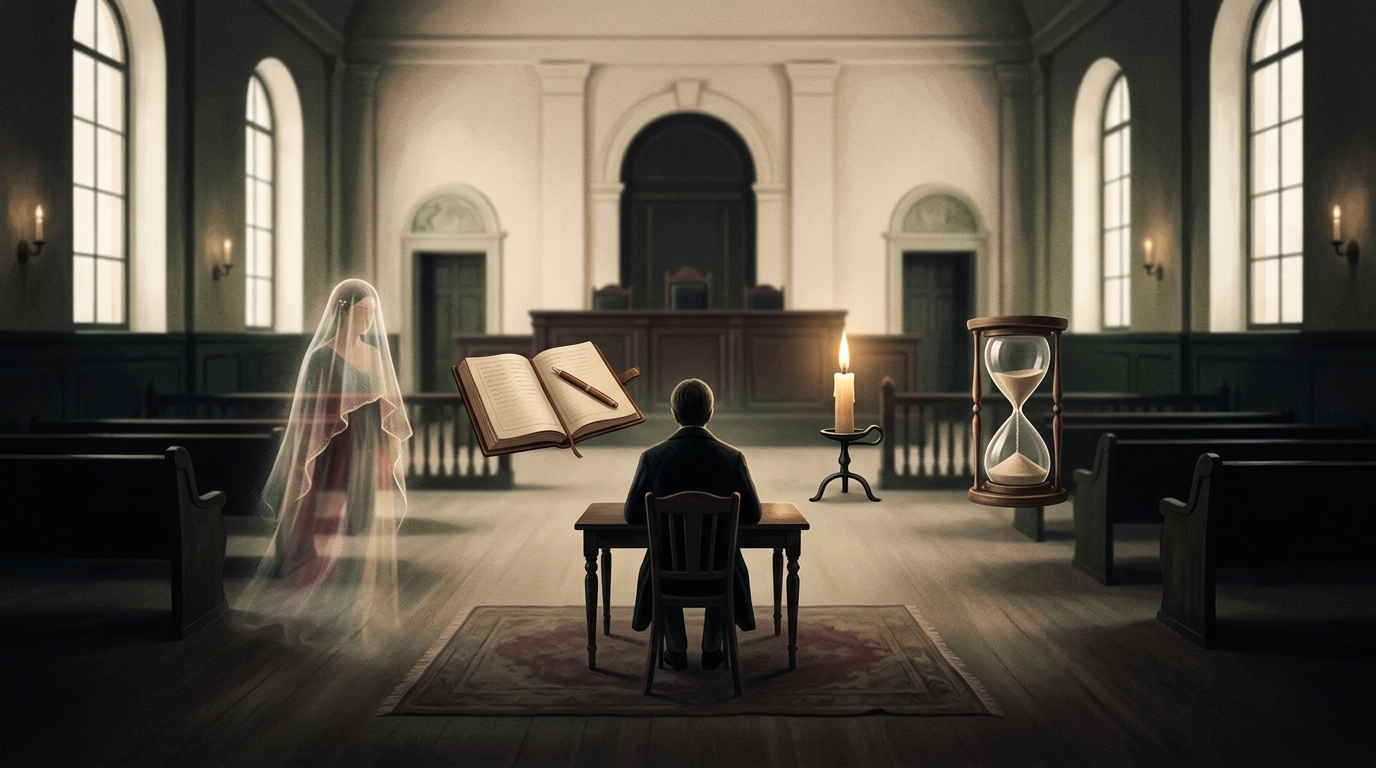
But then the lines kept repeating in my head: "एक तरफ भ्रम, एक तरफ कर्म", and something shifted. I realized I wasn't translating words anymore. I was translating a courtroom that exists inside every human being.
Four voices. Four forces. And one "I" standing in the middle, trying to figure out which one to listen to.
So I did something unusual. I sat down, closed my eyes, and let the four of them speak to me. Not as concepts from a philosophy textbook, but as people who live inside my chest.
This blog is that conversation.
The Four Characters
Before we begin, let me introduce the voices sitting at my inner table.
भ्रम (Bhrama / Maya): Illusion. The voice that makes me believe the mirage is real. Maya is not a liar. She is a magician. She doesn't hide the truth; she makes the false look beautiful enough that I forget to look for the truth.
कर्म (Karma): Action and its ledger. Karma never argues. Karma simply writes. Every thought, every word, every hidden intention, recorded. Karma is the quiet accountant of my soul.
धर्म (Dharma): Righteousness. Duty. The voice that asks not "what do I want?" but "what is right?" Dharma is the hardest voice to hear because it never shouts. It whispers.
काल (Kaal): Time. Death. The great equalizer. Kaal is not cruel. Kaal is honest. Kaal is the only one who never flatters me.
And then there is "मैं" (I), the one standing in the middle, listening to all four.
The Conversation Begins
I sit down. The four of them are already there.
Maya speaks first (she always does)
"Look at you. You think you're confused? You're not confused, darling. You're comfortable. You've built a whole life out of what I showed you: the job, the image, the relationships, the identity. You call it 'my life.' I call it 'my set design.'"
"You ask why you feel empty? Because you decorated a house that was never yours. You fell in love with a reflection and then blamed the mirror when it cracked."
I want to argue. But I can't.
Karma speaks (calmly, without emotion)
"She's not wrong, but she's not the whole story either. You want to blame Maya for everything? Fine. But who chose to keep looking at her? Who chose to believe her?"
"I don't punish you. I don't reward you. I reflect you. Every time you ignored your conscience and called it 'practicality,' I wrote it down. Every time you knew the truth and chose the comfortable lie, I wrote it down. Every time you hurt someone and justified it, I wrote it down."
"You think the ledger is for after death? No. The ledger is what you're living right now. Your life today is the interest payment on yesterday's choices."
I feel exposed. Karma doesn't shout. Karma doesn't need to.
Dharma speaks (softly, almost painfully)
"Both of them are talking about what is. I want to ask you about what should be."
"You keep asking, 'What do I want?' Have you ever asked, 'What is right, even if it costs me everything I want?' That question is me. I am that question."
"You think dharma is religion? Rituals? Rules? No. Dharma is the quiet thing you know you should do but keep postponing. Dharma is the apology you haven't made. The truth you haven't spoken. The person you haven't forgiven, including yourself."
"And here's the tragedy: you can follow every rule, perform every ritual, and still have no dharma. Because dharma is not in the doing. It is in the intention behind the doing."
I realize I've been avoiding Dharma for years. Not because I disagree with her, but because she never lets me off the hook.
Kaal speaks last (as always)
"You've all been talking about life. Let me talk about the end of it."
"You, मैं, carry this body like it's permanent. You look in the mirror and negotiate with age. You build palaces in your mind and call them 'plans.' But I am the one who will take it all back. Not cruelly. Just... completely."
"Your wealth? I'll make it someone else's inheritance. Your body? I'll return it to the elements it borrowed. Your name? In three generations, no one will remember it. Your 'legacy'? A photograph nobody looks at."
"And you know what? This isn't a threat. It's a gift. Because the moment you truly accept me, the moment you accept that everything you cling to is borrowed, you become free. Fearless. Light."
"You want to know why you're anxious all the time? Because you're trying to hold water in your fist. I am the one who tells you: open your hand."
I sit in silence. The room feels both emptier and fuller.
What I Understood: The Courtroom's Verdict
Here's the truth I walked away with.
These four are not enemies. They are not even separate.
- Maya shows me the world.
- Karma records how I respond to it.
- Dharma tells me the right way to respond.
- Kaal makes sure I don't have forever to decide.
And "मैं", I, am not a victim of these forces. I am the witness. The one who chooses.
The song said:
जो दिख रहा है वो सच नहीं है, सच कहे मैं खुद को प्रकट कर रहा हूँ।
Translation:
What appears is not the truth. To speak the truth, I am revealing my own self.
This line, I now realize, is the key to the entire philosophy.
The "I" in the song is not the ego. The "I" is the witness-consciousness, the आत्मा (soul/self) that watches all four forces play their roles. When the song says "मैं खुद को प्रकट कर रहा हूँ", "I am revealing myself," it means:
The truth is not out there to be found. The truth is in here to be uncovered.
Maya covers it. Karma tests it. Dharma guides it. Kaal purifies it. And the Self reveals it.
The Deeper Layers
For those who want to go further.
1. Maya is not evil. She is a teacher.
Indian philosophy doesn't say the world is false. It says the world is impermanent. Maya's job is not to deceive you forever; it's to make you seek the truth. You only look for water when you're thirsty. Maya creates the thirst.
2. Karma is not punishment. It is physics.
Karma is not a god deciding your fate. It's a law, like gravity. Just as dropping something makes it fall, every action creates a reaction. The "ledger" is not a book in heaven. It is your own character, which becomes your destiny.
3. Dharma is not morality. It is alignment.
Dharma is not about being "good" in a social sense. It's about aligning your actions with your deepest truth. That's why dharma is different for different people and different stages of life. A student's dharma is different from a parent's. A warrior's dharma is different from a monk's. Dharma asks: "In this moment, what does truth require of me?"
4. Kaal is not the enemy. He is the liberator.
Death is not punishment. Death is the deadline that gives life its meaning. Without Kaal, we would postpone truth forever. Kaal is the reason urgency exists. Kaal is the reason now matters.
The Four in One
Here's the secret the song hides in plain sight.
Maya, Karma, Dharma, and Kaal are not four things. They are four faces of the same reality.
- When you see reality as appearance, you call it Maya.
- When you see it as consequence, you call it Karma.
- When you see it as responsibility, you call it Dharma.
- When you see it as impermanence, you call it Kaal.
And when you see all four together, you call it Truth (सत्य).
The "I" standing between them is not confused. The "I" is awakening.
Final Reflection: What I'm Taking With Me
I started this blog thinking I was translating a song. I'm ending it realizing the song was translating me.
The verses aren't lyrics. They're a mirror.
And the four voices aren't external. They're internal. They've always been speaking. I just never sat still long enough to listen.
So here's my question to you, the reader:
When was the last time you sat down with your own Maya, Karma, Dharma, and Kaal?
When was the last time you let them speak, not to fight, but to be heard?
Because the courtroom is always in session.
The only question is whether you're present for the hearing.
"मैं खुद को प्रकट कर रहा हूँ" "I am revealing myself."
Maybe that's the whole point.
Not to find yourself. But to reveal yourself, layer by layer, illusion by illusion, until only truth remains.
Loading comments…