Muzaffarpur memories, a Dubai evening, and a festival that asks for nothing but gratitude.
Today, I received an invitation: a Hindi card in saffron and gold, a sun low over rippling water, and four dates in a neat column. 13, 14, 15 and 16 November 2026. I read it far from home, in Dubai, and for a moment I was back in Muzaffarpur.
The pond behind the cow shed
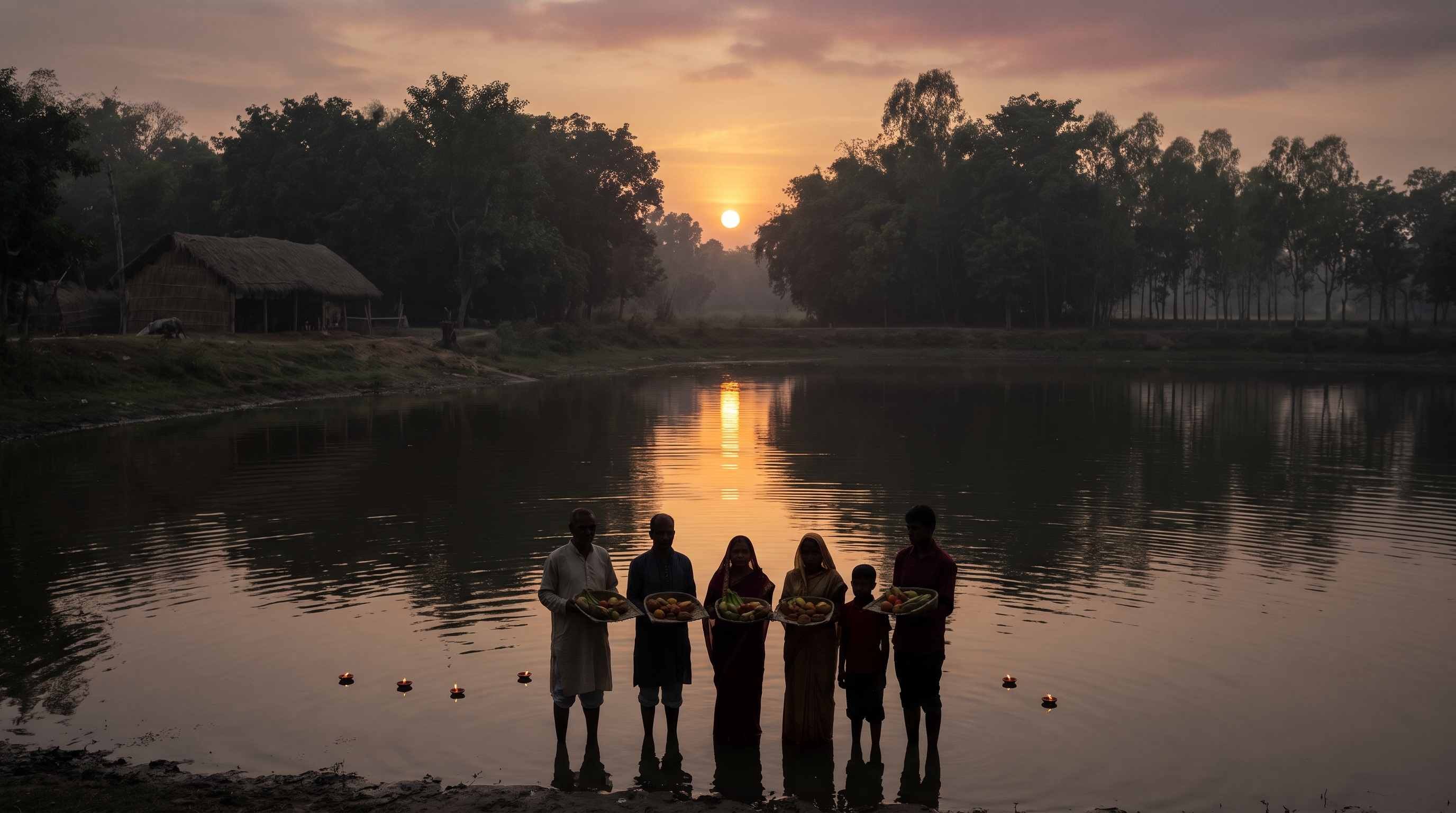
I never kept the fast. My role was smaller, and I now think no less meaningful: I was my mother's chauffeur. She had a friend whose house had a pond in the backyard, right beside the cow shed, and for Chhath that pond became our ghat. There were no marble steps and no grand arrangements. What there was were people: a huge, immediate joint family of relatives, friends and neighbours, so many that it was hard to say where one household ended and another began. Baskets of fruit and thekua, diyas at the water's edge, the sun slipping behind the trees.
I drove, I waited, I watched. I did not understand then how much quiet devotion I was standing inside.
Four days, one discipline
Chhath falls in the lunar month of Kartika, in the days after Diwali, and in 2026 it runs across four days:
-
Nahay Khay, Friday 13 November:
bathing, cleaning the home, and one pure meal of lauki, chana dal and rice, cooked without onion or garlic.
-
Kharna, Saturday 14 November:
a day without food or water, broken after sunset with kheer, roti and fruit, which begins the 36-hour waterless fast.
-
Sandhya Arghya, Sunday 15 November:
devotees stand in water and offer arghya to the setting sun, with bamboo soops of fruit, sugarcane and thekua.
-
Usha Arghya, Monday 16 November:
before sunrise, the same offering to the rising sun, followed by Paran, the breaking of the fast with prasad shared among family and neighbours.
What the sun and water say
Most festivals gather around an image. Chhath gathers around what we can actually see: the sun and the water. No priest stands between the devotee and the divine, and everyone stands in the same water, whatever their caste, class or gender. The offerings are organic and served in bamboo, clay and leaf, so even the vessels return to the earth.
And it honours both the setting and the rising sun. The evening arghya respects endings, elders and the full cycle of a day. The morning arghya greets hope and a fresh start. Few traditions are this honest about the fact that both belong to the same light.
Why it matters now
In 2026, we live in a world that is always on, always optimising, always asking what is next. Chhath answers with 36 hours of deliberate scarcity, a fast that cannot be performed for anyone, because no one can eat or drink on your behalf. In a season of constant noise, it offers stillness. In a culture that worships the new, it begins by bowing to the setting sun.
It is also a quiet lesson in shared commons. Ponds, rivers and ghats are only sacred if they are clean, and a festival built on water is a yearly reminder that we depend on them. For those of us far from our river, it travels anyway: on apartment balconies, in community gatherings, in a WhatsApp card that can pull a grown man back to a village pond.
What I take from it
The pond in Muzaffarpur taught me that ritual needs no grandeur, only presence. The invitation I received says that a guest's presence makes the festival more auspicious, and I find that humbling. Perhaps that is the real teaching of Chhath:
Gratitude is not something we perform for the sun. It is something we practise together, standing in the same water.
A wish for family and friends
To my family, friends, neighbours and everyone who has shared a festival with me, wherever you stand this week: may the fast be gentle on those who keep it, may your kitchens be calm and your homes full, and may Chhathi Maiya and Surya Dev bless you with health, prosperity and light.
छठ पूजा की हार्दिक शुभकामनाएँ। 🙏
Loading comments…