Navyaa

Welcome to NAVYAA—a space created for hearts that feel deeply. This blog is for sharing, reflecting, and supporting growth in relationships and emotional self-discovery, focusing on healing, empathy, and honest connection.

  • The Worst Five Minutes: Why I’d Still Choose to be Human

    ​I saw a video today that stopped me mid-scroll. It wasn’t a travel vlog or a productivity hack; it was just a guy sitting at a table, talking about a rock.

    ​He posed a question that’s been rattling around my brain ever since: If you told a stone it could experience five minutes of human life—but only the worst, most painful five minutes—would it take the deal?

    ​His answer? The rock would fight to be first in line.

    ​The Awe of the Ordinary

    ​We spend so much of our lives trying to “fix” our sadness or escape our stress. We treat negative emotions like bugs in the software of our existence. But to a rock—something that has sat in silence for two hundred million years—even our deepest grief would be a miracle.

    ​Think about it. To a stone, the fact that we have hands to touch, eyes to distinguish a sunset from a grey morning, and a consciousness intricate enough to feel “emo” is a level of complexity that is almost divine. We can look at another person and connect. We can derive meaning from the color of a leaf.

    ​We complain about the weight of our lives, forgetting that having weight means we actually exist.

    ​The “God” Perspective

    ​Then, he took the metaphor a step further, and this is where it got heavy.

    ​What if we are the rocks? What if our entire human existence—the heartbreak, the bills, the existential dread—is just the “worst five minutes” of a higher, divine consciousness?

    ​Even in those “worst five minutes,” we’ve managed to create art. We’ve built philosophies so deep they can pull us out of the mud. He mentioned Rumi and the concept of Ecstasy—that specific human ability to transcend pain through wonder.

    ​Choosing the Five Minutes

    ​It’s easy to feel like life is a series of problems to be solved. But when you look at it through the eyes of the mountain minding its own business for eons, the “problem” of being human starts to look a lot like a privilege.

    ​Even if this life is just a brief, messy window of consciousness before we “disintegrate” back into the earth, I think I’m with the rock. I’d take the deal. I’d take the worst five minutes just to know what it feels like to be here, to think, and to be in awe of the fact that I have hands at all.

    So, the next time you’re feeling a little too “emo” about the world, remember: Somewhere, a rock is probably incredibly jealous of your bad day.

    #PerspectiveShift #HumanExperience #ExistentialDread #DeepThoughts #ModernPhilosophy #MindfulnessMatters #Sentience #Consciousness #RumiQuotes ​#InnerPeace #GratitudePractice #SpiritualAwakening #LifeAdvice #CoreMemories #HumanCondition #MentalHealthAwareness #EverythingIsFine #PointOfView #Storytime #DeepTok #WisdomQuotes #SelfReflection #PersonalDevelopment #Perspective #MindsetGrowth #EmotionalIntelligence #Philosophy #Life #Humanity


  • Dare to Dream: Embracing Life Beyond Comfort Zones

    One day, you will look back. The view from that future point will be crystal clear. And in that moment, you will answer one question with your entire life’s evidence: Am I proud of this?

    Or will you be haunted by a different, quieter ghost? The ghost of what could have been. The career that called your name, but you never answered. The risk that pulsed with life, but you deemed too dangerous. The version of yourself—bolder, brighter, freer—that you imagined but never built. All because playing it safe felt easier in the short term.

    Let’s be honest: most people settle. They master the art of the graceful shrink, folding their dreams into smaller and smaller shapes until they fit neatly inside a box labeled “Fine.” They tell themselves convincing stories: “I never really wanted more,” or “This comfort is enough.” They trade the dizzying heights of potential for the solid, predictable ground of “just getting by.”

    But you know better.

    You feel that restless pull. You hear the whisper of a path not taken. The real tragedy isn’t failure; it’s the silent surrender that happens long before you even step onto the field. The only thing worse than failing is realizing you never tried.

    So, what now? The antidote to a future of quiet regret is present-day deliberate action. It starts by setting your sights on something that excites you, something that makes your heart beat faster just thinking about it. Then, get brutally honest: does it also terrify you? Good. That means it’s worth something. True growth—the kind that fills you with pride when you look back—always happens on the other side of that fear.

    Stop negotiating with your own potential. Stop asking for permission to want a bigger life. The blueprint isn’t found in someone else’s approval or in the well-worn path of the settled.

    It’s found in the silent decision to choose curiosity over comfort.
    It’s built by listening to the pull more than the panic.
    It’s forged in the understanding that a life of safety is often the riskiest bet of all.

    Don’t let your greatest legacy become a collection of elegantly crafted excuses. Don’t let “fine” be the epitaph on your dreams. Start building the life that will make future-you lean in, smile, and whisper with hard-earned pride: “Yes. I did that.”

    The time to begin is not someday. It’s now, with the very next choice you make.


    ✨ Want to take a step today? Try this: Write down one thing that excites and terrifies you. Then, beneath it, write the smallest, simplest first action you could take this week to move toward it. Not the whole plan—just the first brick.

    #NoRegrets #TakeTheLeap #FaceYourFears #LivingWithPurpose #LifeGoals #RiskTaker #CourageOverComfort #JustStart #MotivationDaily #MindsetShift #Inspiration #PersonalGrowth #SelfImprovement #Motivation #SuccessMindset

  • The Courage to Let Go: Embracing Life’s Kites

    There’s a particular kind of ache that comes not from losing something suddenly, but from the slow, draining realization that you must be the one to let it go.

    The other day, I was reminded of a simple, profound truth while watching an old Hindi verse float through my memory:

    “Bahut door nikal gayi thi meri patang,
    mujhe dhaga todna hi thik laga,
    samet’ta to aur ulajh jata.”

    (My kite had flown very far away,
    so I felt it was better to just break/cut the string,
    if I had tried to reel it back in, it would have only gotten more tangled.)

    On the surface, it’s a scene from childhood—a kite sailing beyond reach, a small hand holding a spindle. But beneath that, it’s one of the most mature metaphors for release we’ll ever encounter.

    The Kite That Flies Too Far

    We’ve all had those “kites.” The project that spiraled beyond its original scope, draining our energy and joy. The relationship that stretched over miles or misunderstandings, sustained only by a thin, straining thread of hope. The dream that evolved into something unfamiliar is now flapping wildly in winds we no longer understand.

    For a long time, we believed our duty was to reel it back. To tighten our grip, to pull harder, to devote more strength and focus to restoring what once was. We equate letting go with failure and persistence with virtue.

    The Tangle of Trying to Reel It In

    But the verse highlights a subtle wisdom: sometimes, the act of retrieval creates a bigger mess.

    Think about it. When you try to force a distant kite back, the string slackens, catches crosswinds, and wraps around obstacles—or worse, around other kites, pulling them down too. The gentle tug becomes a frantic yank. What was once a simple line becomes a snarled knot, impossible to undo.

    In life, this “tangle” is the drama, the burnout, the resentments, and the compounded complications that arise when we try to forcibly salvage what has naturally drifted beyond its season. We don’t just risk losing the kite; we risk injuring our hands and endangering our peace.

    The Courage to Cut the String

    Choosing to break the string isn’t passive. It’s not “giving up.” It’s a conscious, painful, and profoundly active decision. It’s saying, “I see that the cost of bringing this back is greater than the sorrow of setting it free.”

    It’s honoring the distance. It’s acknowledging that the kite was meant to fly, and maybe its journey took it somewhere you cannot follow. There’s a strange grace in that release. You open your hand not in weakness, but in respect—for the kite, for the wind, and for your own limits.

    What Remains in Your Hands

    When the string is cut, there’s a moment of startling quiet. The constant tension in your palm vanishes. You’re left with a bare spindle. It feels empty, but it is also clean, unburdened, and ready.

    Ready for what? For a new string. For a new day. Perhaps for a new kite, or perhaps for a while, just for the feeling of the sun on your face without the strain in your shoulder.

    Letting go is the ultimate act of trust—trust that the sky can hold what you cannot and that your hands were made for both holding and opening.

    The freedom you seek might not be in pulling something closer but in granting it—and yourself—the permission to drift apart.

    What’s a “kite” you’ve had to let fly? Was there a moment you realized pulling harder would only create a deeper tangle? Share in the comments below.

    #lettinggo #poetry #mindfulness #selflove #healing #innerpeace #wordstoliveby #kitemetaphor #lifelessons #growthmindset #letgo #reflectivewriting #healingjourney #surrender #wisdomquotes #patang #emotionalfreedom #metaphor #acceptance #selfreflection

  • Prioritizing Self-Care: Showing Up for Yourself

    We talk a lot about “showing up.” It’s a badge of honor, a marker of good character. But we rarely talk about what it costs to show up when you’re running on empty. I’m here to talk about that cost.

    I showed up.
    I showed up with my eyelids heavy and my spirit drained on two hours of sleep because you needed a ride, a listener, and a shoulder.
    I showed up when my bank account echoed, buying the coffee, covering the ticket, and smiling through the knot of financial anxiety in my stomach because your need felt more immediate than my own.
    I showed up with a heart freshly cracked, my own pain neatly boxed and shelved so I could hold space for yours. I handed out Band-Aids while I was quietly bleeding.

    I showed up for you when I was silently screaming for someone to show up for me.

    And perhaps the hardest truth? I showed up for people who, deep down, I knew would never cross the street for me if the roles were reversed. I operated on a one-way street of empathy, fueled by a hope that my loyalty would be a deposit in some relational bank, earning future returns of care. Too often, the account remained empty.

    That is why I will never water down or apologize for the season of life I’m in now.

    This season looks different. It’s quieter. It has firmer boundaries. It says “no” more often. It prioritizes rest without guilt. It spends quiet evenings alone, relearning the sound of my own thoughts. It invests time in what fills me up, not just what drains me, for the benefit of others.

    To the outside eye, it might look like I’ve changed. That I’ve become less generous, less available, and more “selfish.”

    But you don’t know the half of what it took to get here.

    You didn’t see the years of internal overdraft. You didn’t feel the slow erosion of self that comes from constantly prioritizing everyone else’s map over your own destination. You weren’t there for the quiet moments of exhaustion where I wondered who I was outside of being a supporter, a fixer, a pillar for others.

    This season isn’t a punishment to the world. It’s my long-overdue rescue mission for myself. It’s the necessary repair work on a foundation I let others build upon while the cracks widened beneath me.

    I am not bitter. I am healed enough to understand that my past choice to show up, even foolishly, came from a place of deep love and capacity. That person who showed up is still me. But he’s wiser now. He’s learned that you cannot pour from an empty cup, and that allowing your cup to be perpetually drained is not virtue—it’s self-abandonment.

    So, I make no apologies for protecting my peace. I offer no diluted explanation for my need for space, for silence, for intentional self-care. This season is sacred. It is the direct result of a debt I paid to my own spirit, in installments of fatigue, financial strain, and emotional labor, for far too long.

    I showed up for everyone else. Now, finally, unflinchingly, I am showing up for me. And that is the most important commitment I will ever keep.

    #personaldevelopment #personalgrowth #selfgrowth #selfimprovement #selfcare #selflove #boundaries #selfcarematters #selflovejourney #mindset #growthmindset #mindsetiseverything #abundancemindset #shiftyourmindset #mentalhealth #mentalhealthmatters #emotionalwellbeing #mentalhealthawareness #empathy #compassion #healing #itsokaynottobeokay #youarenotalone #endthestigma #mentalhealthsupport #personaldevelopmentjourney #myjourney #storytelling #lifelessons #authenticity #resilience #innerstrength #growth #transformation

  • The Masks We Wear: Understanding Hidden Battles

    I was sitting in a coffee shop yesterday, stealing moments of other people’s lives between sips of my latte. The scene was a perfect postcard of normalcy. A couple shared a laugh in the corner. A focused individual typed furiously on their laptop. A group of friends huddled over their phones, erupting in occasional, synchronized giggles.

    And as I watched, a single, clear thought cut through the ambient noise: Everyone here looks so… put together.

    It was followed by a quieter, more certain truth: We are all just pretending we have it figured out.

    Look closer, the mind whispers. That picture-perfect couple, their laughter echoing? They might be one unkind word, one forgotten anniversary, or one stressful drive home away from a shattering argument. Their laughter isn’t a lie, but it’s not the whole story.

    That person on the laptop, radiating productive energy? The screen might be filled with spreadsheets of overwhelming debt, a job application for the tenth time, or a blank document that screams of creative block. The focused expression is a mask for a mind that might be drowning.

    That tight-knit friend group, a fortress of camaraderie? Between the inside jokes, there could be silent jealousies, old wounds carefully avoided, or secrets so heavy they bend the spine of their friendship, never to be spoken aloud.

    We are all, every single one of us, fighting invisible battles. We move through the world wearing carefully curated masks that say, “I’m fine.” “I’m capable.” “I’m happy.” We wear them for others, and sometimes, we wear them so convincingly we start to believe them ourselves.

    But behind the mask? There’s the anxiety that hums like a low-frequency current. The grief that sits patiently in a corner of the heart. The fear that whispers of not being enough. The exhaustion of just keeping up.

    And maybe—no, definitely—this is why kindness isn’t just a nice idea. It’s a critical, urgent necessity. It’s the oxygen in a room where everyone is secretly holding their breath.

    You never know who is barely holding on. The barista who handed you your coffee might have just gotten devastating news. The stranger you held the door for might be carrying a weight you can’t see. The colleague you greeted warmly might have spent the morning wrestling with a private despair.

    That smile you offer isn’t small. That moment of patience in traffic isn’t trivial. The decision to listen instead of just waiting to speak? It’s a revolution.

    We are all just trying to make it through the day, the week, and the year, hoping that if we start to crumble, someone might notice. Hoping for a moment of grace, a glance that says, “I see you,” not just your mask.

    So today, be gentle. Assume the struggle. Your simple kindness—the held door, the sincere “thank you,” the choice not to judge—might be the soft place someone needed to land. It might be the tiny, invisible thread that helps them keep holding on.

    Because we’re all in this coffee shop of life, sipping our bittersweet blends, wearing our masks, and silently hoping for a little kindness to make the pretending feel a little less lonely.

    #mentalhealth #mentalhealthmatters #mentalhealthawareness #youarenotalone #itsokaynottobeokay #mindfulness #selfcare #selflove #endthestigma #kindness #kindnessmatters #bekind #compassion #spreadkindness #choosekindness #actsofkindness #empathy #socialissues #humanity #community #invisiblebattles #personalgrowth #perspective #mindset

  • Understanding the Split: Navigating Dual Selves in Our Lives

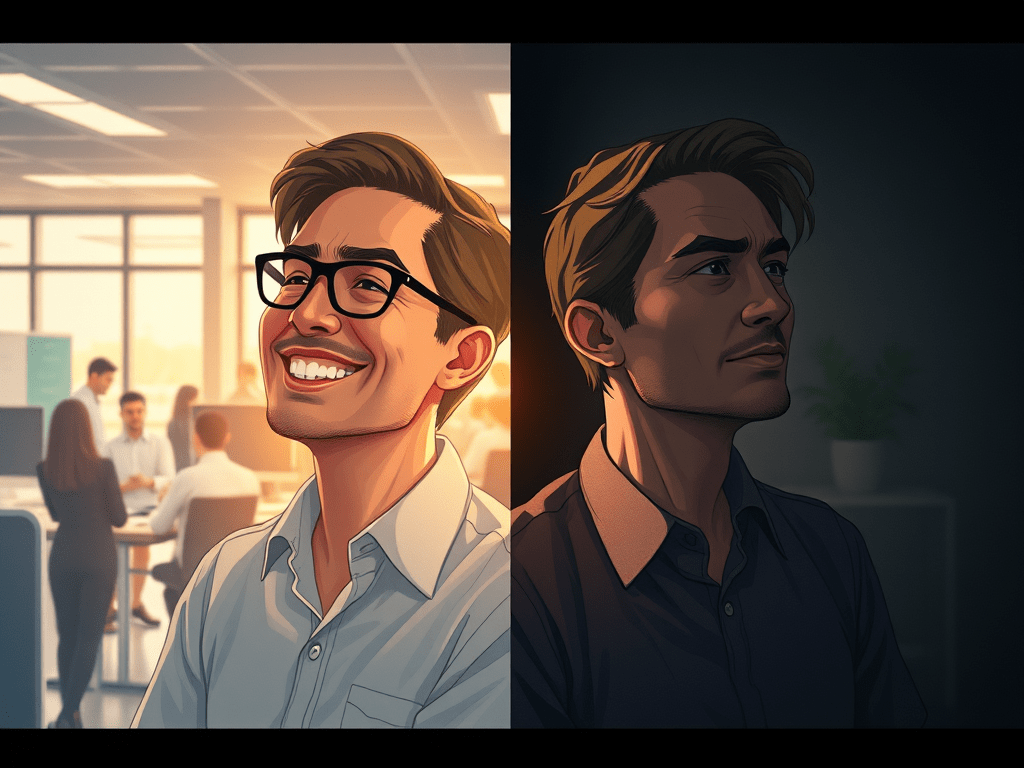
    We all have versions of ourselves we present to the world. Most days, I slip into mine without thinking.

    There’s the version of me that shows up every day.
    The one who clocks in (or logs on), meets deadlines, and answers “How are you?” with a bright “I’m good, thanks!” even when the words taste like cardboard.
    This version smiles at the right moments, laughs at jokes that aren’t particularly funny, and cracks a few of my own to keep the energy light.
    People call this version reliable. Easygoing. Fun to be around.
    They don’t see the scaffolding holding it together.

    And then there’s the other version—the one that only appears when the door closes, the lights dim, and the audience is gone.

    This version sits in the dark afterward.
    Hollowed out.
    Not dramatically sobbing or breaking things—just… empty. Staring at the wall or the ceiling, replaying the day like looped security camera footage. Wondering what exactly was said, whether the smile looked real enough, and whether anyone noticed the lag between what I said and what I felt.
    This version doesn’t speak. It just exists in the quiet, heavy silence, carrying the weight of everything the daytime version refused to acknowledge.

    The poem that haunts me lately puts it perfectly:

    There’s a version of me
    that shows up every day,
    does what’s expected,
    smiles, laughs and jokes

    and then there’s the version of me
    that sits in the dark afterward,
    hollowed out,
    wondering how long i can keep
    splitting myself in two.

    I didn’t write those words, but I could have. They echo in so many late-night scrolls, so many quiet car rides home, so many moments when the mask slips just enough to feel the cold air underneath.

    This splitting isn’t dramatic or cinematic. It’s mundane. It’s sustainable… until it isn’t.

    The daytime version is survival mode—a carefully calibrated performance shaped by years of learning what keeps conflict low, expectations met, and relationships intact.
    The nighttime version is the cost of admission. The emotional overdraft. The part that pays interest on every forced smile and swallowed feeling.

    And the question that lingers longest isn’t “Why do I do this?” (The answers are usually obvious: work, family, society, fear of being “too much” or “not enough.”).
    The question is quieter, more urgent:
    How long can I keep splitting myself in two?

    Because every day, the divide grows a little wider.
    The daytime version gets better at performing—more polished, more automatic.
    The nighttime version gets quieter, more tired, and more convinced that this is just how life works now.

    But it doesn’t have to be forever.

    The first crack in the pattern usually isn’t a big breakdown. It’s smaller:

    • Saying “actually, today was rough” instead of “fine.”
    • Turning down an invitation without inventing an elaborate excuse.
    • Letting someone see the hollowed-out version for ten seconds before the mask snaps back.
    • Writing it down. Naming it. Letting the two versions meet in the same room for once.

    It’s terrifying. And it’s exhausting in a different way.
    But it’s also the only path that leads somewhere other than deeper exhaustion.

    If you’re reading this and the words feel like they were pulled from your own chest, know this:
    You’re not broken for having two versions.
    You’re human in a world that often demands performance over presence.

    And you’re not alone in wondering how long you can keep it up.

    The real courage isn’t in never splitting.
    It’s in slowly, carefully, starting to let the two versions talk to each other—until one day they might not have to live so far apart.

    Take care of the version sitting in the dark tonight.
    He’s been carrying a lot.

    #MentalHealth #MentalHealthAwareness #MentalHealthMatters #SelfCare #Healing #YouAreNotAlone #EndTheStigma #MentalHealthSupport #ItsOkayNotToBeOkay #Burnout #Anxiety #Depression #MentalHealthJourney #HighFunctioningAnxiety #EmotionalExhaustion #SelfCompassion #MentalHealthMatters #Masking #TwoVersionsOfMe #HollowedOut #SplittingMyself #MentalHealthRecovery #Therapy #Wellness #Mindset

  • Exploring the Spiritual Depth of ‘Kalank’

    Redefining “Kalank” (The Stain)

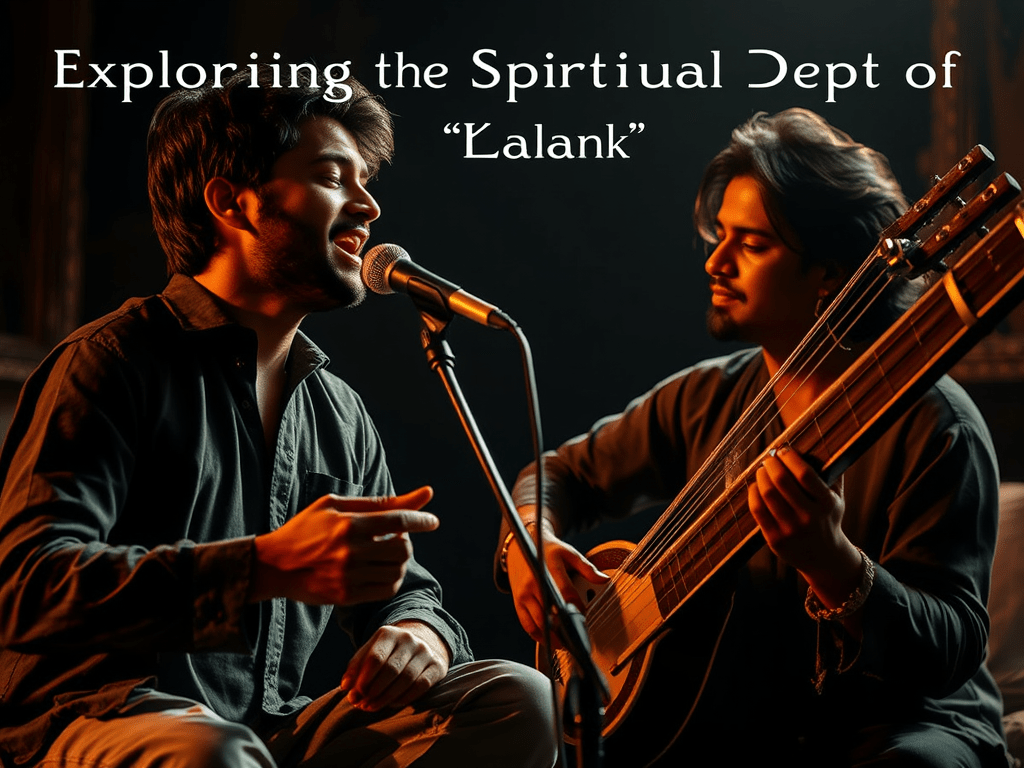
    A Beautiful rendition of “Kalank” by Shom Chaterjee and Dr. Rajeeb Chakraborty

    What a soulful piece! There is something about the pairing of a vocal and a Sarod—a fretless instrument known for its deep, echoing, and almost “weeping” quality—that elevates a Bollywood track into something far more spiritual.

    There are songs that we hear, and then there are songs that we feel. When the strings of a Sarod begin to weep and a voice rises to meet them, you aren’t just listening to music; you are witnessing a conversation between two souls.
    In this intimate session, Chaterjee and Chakraborty strip away the orchestral grandeur of the original film track, leaving us with something raw, haunting, and profoundly human.

    The State of Mind: Surrender
    The “state of mind” reflected in this song is one of absolute surrender. In a world that demands we be “practical,” this song is an anthem for the dreamer.
    The lyrics “Hawaaon mein bahenge” (We will flow in the winds) suggest a loss of ego. The singer isn’t trying to control the destination; they are willing to be carried by the current of their emotions. It is a peaceful, almost meditative headspace where the external world ceases to exist, leaving only the “Piya” (the beloved).

      The Duality of Nature
      The song beautifully uses metaphors of the natural world to explain the codependency of deep love:

        • The Rain and the Cloud: “Toh barkha meri, main tera baadal piya” (Then you are my rain, and I am your cloud).
        • The Meaning: One cannot exist without the other. A cloud has no purpose without the potential for rain, and rain cannot fall without the cloud’s sacrifice. This suggests that true love isn’t just about “being together”—it’s about being parts of the same phenomenon.

        Redefining “Kalank” (The Stain)
        The most powerful realization comes in the final lines: “Kalank nahi, ishq hai kaajal piya.” * The Stigma: A “Kalank” is a stain, a mark of shame or social disgrace. In the context of the song, it refers to love that the world might look down upon—love that is “forbidden” or “imperfect.”

          • The Transformation: The song argues that what the world calls a “stain,” the lover sees as Kaajal (kohl). Kohl is technically a black mark, but it is used to beautify the eyes and protect the wearer.

          The Real Meaning:

          The song is a defiant statement that love—no matter how messy or socially difficult—is a source of beauty and protection, not shame. It is the “black mark” that makes the vision clearer.

          Final Thoughts
          Listening to this version feels like sitting in a quiet room at 2:00 AM, admitting the truths we hide during the day. It’s a reminder that love isn’t always a sunny day; sometimes, it’s a heavy cloud, a dark mark of kohl, or a wandering wind. And that is exactly what makes it sacred.

        1. Exploring the Metaphors of ‘Paper Wings’ Song
          ​(Singing in Hindi)

          Kagaz ke do pankh leke ud chala jaaye re

          (With two wings of paper, it flies away)

          Jahaan nahi jaana tha ye wahi chala haaye re

          (To the place it wasn’t supposed to go, it has gone there)

          Umar ka ye tana-bana samajh na paaye re

          (It cannot understand this web of age)

          Zubaan pe jo moh-maya, namak lagaye re

          (The worldly attachments on the tongue, it tastes like salt)

          Ke dekhe na bhale na jaane na daye re

          (It doesn’t see, doesn’t care, doesn’t know any bounds)

          ​(Switching to Bengali)

          Disha haara kemon boka monta re

          (How foolish is this heart; it has lost its way)

          This song, often referred to as “Mon Ta Re” or “Kagaz Ke Do Pankh,” is a beautiful fusion of Hindi and Bengali folk styles. It captures the restless, often irrational nature of the human heart through metaphors of fragility and wandering.

          ​Here is a deeper look at the themes and metaphors within the lyrics:

          1. The Metaphor of “Paper Wings.”

          ​The opening line, “Kagaz ke do pankh leke ud chala jaaye re” (With two wings of paper, it flies away), is a powerful image of fragility.

          • Meaning: Paper is easily torn, soaked, or burnt. By giving the heart “paper wings,” the lyrics suggest that our desires and dreams are delicate and perhaps not built for the harsh realities of the world. Yet, despite this weakness, the heart is daring enough to try and fly.

          2. The Heart’s Disobedience

          ​The lyrics emphasize that the heart has a mind of its own: “Jahaan nahi jaana tha ye wahi chala jaaye re” (To the place it wasn’t supposed to go, it has gone there).

          • Meaning: This speaks to the “forbidden” or “illogical” nature of attraction and ambition. We often know what is bad for us, yet our emotions pull us toward those very things—be it a toxic relationship, a lost cause, or an impossible dream.

          3. The Web of Time and Experience

          ​The line “Umar ka ye tana-bana samajh na paaye re” refers to the “warp and weft” (tana-bana) of a fabric, symbolizing the complex web of life and aging.

          • Meaning: As we grow older, life becomes more complicated with responsibilities and societal expectations. The heart, however, remains “childlike” and fails to grasp these complexities, often acting out of sync with one’s actual stage in life.

          4. The Bitter-Sweetness of Attachment

          “Zubaan pe jo moh-maya, namak lagaye re” (The worldly attachments on the tongue, it tastes like salt) is a particularly poetic observation.

          • Meaning: “Moh-maya” refers to the illusion of worldly attachments. Comparing it to salt on the tongue suggests that while attachment is a basic “seasoning” of life, too much of it is stinging or bitter. It implies that our desires often leave a sharp, lingering taste rather than pure sweetness.

          5. The “Directionless” Soul (The Bengali Conclusion)

          ​The shift to Bengali for the final line adds a soulful, folk-rooted depth: “Disha haara kemon boka monta re” (How foolish is this heart, it has lost its way).

          • Meaning: “Disha haara” means “lost direction.” It’s a final sigh of resignation, admitting that despite all its efforts to fly, the heart is ultimately a “fool” (boka) wandering aimlessly because it follows emotion over logic.
          Summary of Themes
          • Innocence vs. Experience: The heart’s innocence vs. the world’s complexity.
          • Fragility: The vulnerability of human emotions.
          • The Subconscious: The idea that we aren’t always in control of our own desires.
          • #Soulful Melody #PoeticLyrics #DeepThoughts #Melancholy #wanderlustMusic #VintageVibes #fyp

        2. Why Happiness is Never Truly Free

          These lines touch on a profound, almost haunting reality of human existence: the Law of Conservation of Emotion. It suggests that happiness is never created from nothing; it is simply transferred, often at a heavy price.

          Here is an elaboration of the deep insight behind each thought:


          1. The Transfer of Fortune

          “Kabhi socha hai ki yeh jo tumhe mila hai, yeh kisi ne toh khoya hoga”

          The Insight: Life is a cycle of gain and loss. This line humbles the receiver by suggesting that your “win” is someone else’s “loss.” It removes the ego from achievement and replaces it with the realization that the universe is constantly redistributing its treasures. What you celebrate today is the very thing someone is grieving tonight.

          2. The Echo of Past Tears

          “Yeh jiske saath muskura rahe ho tum, uske liye kabhi toh koi roya hoga”

          The Insight: This highlights the “emotional history” of people. No one comes to you as a blank slate. The person who makes you laugh today likely left a trail of sorrow somewhere else—perhaps a failed relationship or a family they left behind. It’s a reminder that your joy is built on the ruins of a past heartbreak.

          3. The Necessity of Letting Go

          “Yeh jo haath pakad kar chal rahe ho tum, yeh kahin se toh chhut kar aaya hoga”

          The Insight: This is about destiny and closure. A hand can only hold yours if it has first let go of another. It implies that for a new connection to form, a previous bond had to break. It teaches us to respect the “grip” we have now, knowing how much strength it took for that hand to finally be free enough to find yours.

          4. The Illusion of “Free” Happiness

          “Yeh jo muft mein mil gayi hain na khushiyan tumko, yaad rakhna inka karz kisi aur ne chukaaya hoga”

          The Insight: This is the most piercing realization. We often feel “lucky” when things go well, but the poem argues that luck is just a debt paid by someone else. * In a personal sense, it might mean the version of “you” that is happy today was paid for by the “past you” who suffered in loneliness.

          • In a broader sense, it means your comfort often comes from the sacrifices of others (parents, ex-partners, or even strangers).

          The “Loneliness” Perspective

          When you read these lines while feeling lonely, the insight shifts: you realize that your current pain is actually a payment for someone else’s future joy. It offers a strange kind of comfort—that your “loss” isn’t meaningless; it is the “gain” that the universe is preparing for someone else.

          The Message to the Other Person

          The deep intent here is to say: “Don’t be careless with me.” Because if someone else had to lose me for you to have me, and if I had to suffer to become this person for you, then this relationship is far too expensive to be treated lightly.

          The Final Reflection

          “Nothing in this life is truly ‘free’; we are all just living in a cycle of borrowed happiness. Every hand we hold, every smile we share, and every moment of peace we enjoy was bought with a price—usually paid in someone else’s tears or our own past heartaches. It is a humbling, lonely realization that for us to be ‘here’ today, we had to leave a trail of ‘there’ behind. When you understand that your joy is actually a debt settled by the sacrifices of the past, you stop taking people for granted. You realize that the love you have isn’t just a gift—it’s a responsibility to honor the pain it took to find it.”

          #TrendingReels #ShortFilm #POV #SoulSearching #Reflections #fyp

        3. “If it wasn’t this… then it would be something else.”

          This line carries a quiet, almost liberating realism.

          At its core, it accepts a simple truth about life: problems don’t arrive because of a single event; they exist because struggle is part of being human. If one obstacle hadn’t shown up in this form, it would have appeared wearing a different mask.

          What it really means

          • Life doesn’t pause to become perfect.
            Remove one difficulty, and another takes its place—different name, same lesson.
          • The issue isn’t always the situation.
            Often, it’s timing, expectations, patterns, or unresolved inner work that keeps repeating.
          • Suffering isn’t personal.
            This thought pulls us out of “Why me?” and places us in “This is part of the human experience.”

          Emotional depth

          There’s no bitterness in this statement—only acceptance.

          It says:

          • “I’m done blaming one person, one decision, or one moment.”
          • “I understand now that life doesn’t run on guarantees.”
          • “Had this not happened, I would still have faced something else meant to shape me.”

          That realization often brings calm, not defeat.

          Psychological shift

          When someone truly understands this phrase:

          • They stop obsessing over alternate realities (“If only…”)
          • They release regret tied to a single outcome
          • They stop expecting life to be problem-free and start focusing on resilience

          It’s a mindset that says:

          I don’t need control over everything to be okay.

          Quiet strength in the statement

          This line isn’t about giving up—it’s about letting go of unnecessary resistance.

          It implies:

          • You’re no longer shocked by challenges
          • You’ve made peace with imperfection
          • You trust your ability to handle whatever version of “something else” comes next

          In essence

          “If it wasn’t this… then it would be something else.”
          is the voice of someone who has grown beyond blame, beyond regret, and beyond illusion.

          It’s not pessimism.
          It’s clarity.

          And clarity, more often than not, is freedom.

          #LifePerspective #DeepThoughts #InnerGrowth #MindsetShift #Acceptance #LifeLessons #EmotionalIntelligence #SelfAwareness #LetItBe #Realizations #MentalClarity #ThoughtOfTheDay #GrowthMindset #HealingJourney #WisdomWords #fyp