Navyaa

Welcome to NAVYAA—a space created for hearts that feel deeply. This blog is for sharing, reflecting, and supporting growth in relationships and emotional self-discovery, focusing on healing, empathy, and honest connection.

  • The Power of Smiling Through Adversity

    Muskurayo (Smile)

    Muskurayo, muskurayo agar aaj kahin se haar gaye ho, us jeet ki zarurat tumse zyada kisi ko thi shayad.

    Smile, smile if you have lost today; perhaps someone else needed that victory more than you.

    Muskurayo, agar kuch kho gaya hai, jis ke naseeb ka tha usko mil gaya hai shayad.

    Smile if you have lost something; perhaps it was destined for the person who found it.

    Muskurayo, agar dil toot gaya hai, kisi ka jodne ke liye kisi ka todna padta hoga shayad.

    Smile if your heart is broken; perhaps one heart must break to mend another.

    Aur phir bhi reh jaye agar dil mein dard kahin, to baant kar muskurayo.

    And if there is still pain left in your heart, share it and smile.

    Aur hai agar dil mein khushi zyada, to same process dohrayo.

    And if there is an abundance of joy in your heart, repeat the same process (share it).

    Muskurayo, agar sar par hai chat, badan par hai kapda, aur hai thali mein khana, aur hai agar zarurat se zyada, to baant kar ghar jana.

    Smile if you have a roof over your head, clothes on your body, and food on your plate; and if you have more than you need, share it before you go home.

    Muskurayo, jab baar-baar ye soch kar hatash ho jate ho ki is se accha ye ho jata, is se accha wo ho jata, tab ye soch kar muskurayo ki is se bura ho jata to kya ho jata.

    Smile when you feel despondent thinking “this or that could have been better”; instead, smile thinking about how much worse it could have been.

    Muskurayo, jab pooche koi ki zindagi jeene ka hai kya tareeqa, muskurayo ye keh kar ki hum ne zindagi se muskurana hi seekha.

    Smile when someone asks what is the best way to live life; smile and say that we have learned nothing from life but how to smile.

    This poetry is a beautiful, modern take on stoicism and gratitude. It’s an invitation to shift our perspective from what we lack to what we possess and how we can find peace in every circumstance.
    Here is a personal blog post analyzing the philosophy behind these words.

    In a world that constantly demands more—more success, more possessions, more perfection—we often forget the simplest human response to existence: The Smile. I recently came across a moving piece of Urdu poetry that challenges our typical reaction to hardship. It suggests that a smile isn’t just a result of happiness; it’s a tool for survival and a gateway to a deeper understanding of life.

    The Philosophy of “The Greater Need”
    The poem begins by reframing Loss and Defeat.

    • What is said: If you lose, perhaps someone else needed that win more. If you lose an object, it was simply someone else’s destiny.
    • The Real Meaning: We often view life as a zero-sum game where our loss is a tragedy. The poet suggests a Universal Connection. By viewing our “loss” as someone else’s “blessing,” we remove the ego from the equation. It turns envy into a silent act of charity.

    The Cycle of Emotional Alchemy

    • What is said: If your heart breaks, it might be the “cost” of mending another. If you have pain, share it (to lessen it); if you have joy, share it (to multiply it).
    • The Real Meaning: This is the philosophy of emotional interdependence. It acknowledges that our hearts do not exist in isolation. The “same process” of sharing applies to both grief and joy. This teaches us that vulnerability is a strength; by sharing our burdens, we find community, and by sharing our light, we find purpose.

    Radical Gratitude (The Baseline of Happiness)

    • What is said: If you have a roof, clothes, and food—and especially if you have more than that—share it.
    • The Real Meaning: This is a reality check. Most of our “problems” are high-level anxieties. The poet grounds us in the essentials of survival. True living begins when we realize that “enough” is a feast. The philosophy here is that excess isn’t for hoarding; it’s for distribution.

    The “It Could Have Been Worse” Perspective

    • What is said: Instead of worrying about how things could have been better, smile because they didn’t turn out worse.
    • The Real Meaning: This is a classic Stoic exercise called premeditation of Malory (the premeditation of evils). By acknowledging that the floor of human suffering is much lower than where we currently stand, we find instant relief. It’s not about being pessimistic; it’s about being grateful for the present mercy.

    How to Inculcate This in Your Life
    To understand the “true meaning of living” as described in this poem, try these three shifts:

    1. The 24-Hour Reframing Rule: Next time you face a minor setback (a missed promotion, a lost item), tell yourself: “This was meant for someone who needed it more today.” Feel the weight lift off your shoulders.
    2. The “Same Process” Habit: Don’t just post your highlights. Share your struggles with a trusted friend. When you realize that pain is a shared human currency, it stops feeling like a personal punishment.
    3. Active Comparison: When your mind wanders to what you don’t have, look downward—not in pity, but in recognition. Look at the roof over your head as a luxury, not a given.

    The Bottom Line
    The true meaning of living isn’t about escaping pain or achieving a permanent state of bliss. It is about the grace we maintain while moving through the highs and lows. As the poet beautifully concludes, the best way to live is to simply tell the world: “I have learned nothing from life but how to smile.”

  • The Power of Silence: Reclaiming Your Energy

    There’s a specific kind of silence that follows the moment you realize it. The smile that didn’t quite reach the eyes. The compliment felt a little too heavy, landing with the weight of a secret wish. It’s the chilling understanding that for some people, your light is a glare in their eyes. They’ll stand there, applauding politely, all while quietly hoping you trip on your way to the stage. Everybody clapping isn’t clapping for you.

    I used to think openness was a virtue. I equated oversharing with authenticity, mistaking a listening ear for a trustworthy one. I handed out fragments of my dreams, my fears, and my struggles like confetti, thinking I was building a connection. I was just supplying ammunition. I learned that some don’t want a piece of your joy; they want a front-row seat to your downfall. They crave the spectacle of your stumble, not the story of your success.

    So, I fell back.

    It wasn’t a dramatic exit. It was a quiet retreat into my inner self. A strategic withdrawal from the battlefield of other people’s opinions and hidden agendas. The most profound peace I ever found was the day I stopped begging people to treat me right. You either value me, or you don’t. There is no in-between, no amount of pleading that can manufacture genuine respect. That transaction is void.

    I’ve done my time in the trenches of overthinking. I’ve written novels of excuses for behavior that had no justification. I’ve held onto hope for people who showed me, time and again, who they were. I’ve watered dead plants, convinced they’d bloom if I just cared enough.

    I’m done with all that.

    Now, I operate from a simple, unshakable truth: if my presence doesn’t matter, my absence will.

    This isn’t a threat; it’s a law of physics. You don’t notice the hum of the refrigerator until it stops. You don’t feel the warmth in the room until the heat is gone. My energy, my care, my loyalty—they are not infinite resources to be spent on those who see them as disposable. I am reclaiming every watt of my light.

    This new space is not lonely; it is sacred. It’s where I hear my own voice again, without the static of other people’s noise. It’s where I build things that matter to me, without an audience of secret critics. The people who are meant for me will find me here, in this authentic quiet. They won’t need to be convinced or begged. They will simply see the value, and they will stay; no front-row seat required.

    #SelfPreservation #HealthyBoundaries #EmotionalIntelligence #KnowYourWorth #StopPeoplePleasing #QuietQuitting #ProtectYourPeace #SelfWorth #NoMoreExplanations #LetThemGo

    (Link in Bio)

  • The Beauty of Temporary Love

    It hits you one day, not with a crash, but with a quiet settling. A realization that feels less like a discovery and more like a truth you’ve always known, finally coming into focus: I am not a permanent person in anyone’s chapter.

    For a long time, I thought this was a tragedy. A flaw in my design, a recipe for a heart forever destined to be a visitor. But I’ve come to see it differently. It’s not a failure; it’s a calling. And if that’s the role I’m given, then I have a new mission: to be the most memorable, profound, and beautiful temporary person you have ever met.

    What does that look like? It’s a commitment to a love that doesn’t keep score.

    I stay longer than I should. Not out of obligation or blind hope, but because when I see a flicker of light in someone, I want to fan it until it’s a steady flame. I’ll hold space for your chaos, sit in the silence of your hurt, and celebrate your victories as if they were my own, even when the calendar suggests it’s time to go.

    I love harder than what’s returned. This isn’t about martyrdom. It’s about believing that love in its purest form is an offering, not a transaction. I will pour kindness, attention, and genuine care into you, not because I’m guaranteed a refund, but because you, in that moment, deserve to feel what it’s like to be fully seen and valued. Consider it a gift, no strings attached.

    I give pieces of myself knowing I won’t get them back. Stories, vulnerabilities, insights, and support—these are the fragments of my soul I press into the palms of the people I meet. I don’t give to be replenished. I give because those pieces might one day be the cornerstones you use to build something stronger for yourself.

    And then… I leave.

    But here is the most important part: when I leave, it’s never because I wanted to.

    It’s because I finally heard the whisper my heart has been trying to shout. I understood the assignment. My purpose wasn’t to settle in your story and build a forever home. It was to pass through it—to illuminate a path, to mend a broken piece, to teach a lesson, or simply to prove that a love this selfless could exist.

    I was only ever meant to be remembered, not kept.

    It’s a bittersweet truth. There’s an ache in not being someone’s finale. But there is a profound freedom and beauty in being a breathtaking, transformative season. I am the autumn that taught you to let go with grace. The summer that showed you your own warmth. The spring that convinced you to bloom again after a long winter.

    So if our paths cross, know this: I won’t half-love you. I won’t guard my heart in anticipation of an expiration date. I will love you fully, fiercely, and with my whole being for as long as our timelines overlap.

    And when the trajectory of our lives gently pulls us apart, don’t think of it as an ending because you “lost” me. Think of it as it truly is: you gained a part of me forever. I am a paragraph in your book that you’ll dog-ear. A memory that will visit you on a quiet Tuesday and make you smile. Proof that some people are not meant to be a whole chapter but are instead the highlight of one.

    I am a temporary gift. And I am learning to wrap myself accordingly.

    #temporarylove #temporarypeople #lostlove #heartbroken #movingon #heartache #lovequotes #soulmate #relationship #loveislove #selflove #healing #lifequotes #blogpost

  • Letting Go: Finding Peace in Absence

    You ever have one of those moments where the absence of an answer is the answer?

    I would have texted you again. I had the message drafted in my head a hundred times. A funny meme, a “how are you doing,” a simple question about nothing at all—just a thread to pull, hoping to unravel the distance.

    But I didn’t.

    I stopped because I finally noticed something: you seemed totally, completely, peacefully fine with my absence. And in that realization, the world tilted on its axis.

    It wasn’t a dramatic fight or a final, slammed door. It was the calm. Your calm. It was the undisturbed surface of your life after I’d stepped away from the shore, expecting at least a ripple.

    That calm was the loudest thing I’d ever heard.

    It made me realize that maybe I was the only one still holding on to the ghost of what we were. That maybe, in the quiet equation of “us,” my care had carried a heavier weight. I was investing in a deficit, trying to fix something you didn’t even seem to miss.

    So I stopped too.

    I stopped reaching out first. I stopped the digital archaeology of scrolling through your profile, searching for clues in old photos and vague updates. I stopped trying to glue back the pieces of a connection that, for you, was already whole without me.

    Let me be clear: This isn’t about not caring anymore. The care doesn’t just evaporate. It’s about a deeper, more painful understanding finally settling in my bones.

    If someone can stay calm while you’re gone—if your exit doesn’t even register as a disturbance—then perhaps they never really needed you the way you needed them.

    That’s a hard truth to swallow. We want our leaving to matter. We want our absence to be a presence, a noticeable hole. But sometimes, the space we occupied was just that: space. Easily filled by the quiet, by the mundane, by the simple continuation of a life.

    And in understanding that, there’s a strange kind of freedom.

    This letting go isn’t an act of anger or a game of pride. It’s an act of alignment. It’s me finally looking at the reflection of our dynamic and choosing to step out of the frame. It’s honoring my own need by no longer pouring it into a vessel that was never meant to hold it.

    I’m not waiting by the phone anymore. But I’m also not burning any bridges in a blaze of drama. I’m simply turning around and walking my own path, my hands finally free from carrying something that was only ever mine to carry.

    The silence was your answer. My peace is my reply.

    And sometimes, that’s the most profound conversation you’ll ever have.

    #lettinggo #letgo #healingjourney #movingon #selflove #heartbreak #heartbroken #brokenheart #sad #emotional #blogpost #peace #acceptance #innerpeace #mindfulness #selfcare

    (Link in Bio)

  • The Great Masquerade: When Breathing Isn’t Living

    We’ve mistaken ‘breathing’ for ‘living’ for far too long.

    We’re taught to think of death as a finale—a loud, dramatic event marked by a sudden stop, a ceremony, and a collective outpouring of grief. We have rituals for it because we can see it.

    ​But lately, I’ve been reflecting on a different kind of passing. One that doesn’t make the news or merit a funeral, but is no less devastating. It’s the quiet, internal erosion that happens while the rest of the world thinks you’re doing just fine.

    ​There’s a short poem that has been haunting me because of how accurately it captures this invisible struggle:

    I died quietly,

    Painfully,

    a death no one grieved

    because

    I kept breathing,

    And breathing looks a lot like living

    if you’re not paying attention.

    ​The Great Masquerade

    ​The reason this hits so hard is that we’ve collectively agreed that “breathing” is the ultimate metric for being okay. If you’re showing up to the office, answering emails, and keeping up with the group chat, the world assumes you’re “alive.”

    ​But there’s a massive difference between biological function and human vitality.

    ​I’ve realized that breathing is often just the engine idling. True living requires engagement, hope, and connection. When those things flicker out, a person can undergo a total internal implosion—a quiet death of the spirit—all while maintaining the “great masquerade” of a functional life. Because there’s no visible wreckage, no one thinks to grieve.

    ​The Cost of Not Paying Attention

    ​The most piercing part of those lines is the caveat: “…if you’re not paying attention.” It’s a subtle shift of responsibility. It suggests that the tragedy isn’t just the internal death itself but our collective failure to notice it in one another. We are so conditioned to look for the “loud” signs of crisis—the outbursts, the visible tears, the total shutdowns—that we miss the friend whose laugh has become hollow or the colleague who has become a shadow of their former self.

    ​We see people every day. But how often do we actually perceive them?

    ​A Personal Challenge to Look Deeper

    ​I’ve started to realize that the most profound thing we can offer each other isn’t just “being there”—it’s the gift of truly seeing. It’s about looking past the “I’m fine” and the routine functionality to check if the person inside is still actually there.

    ​This isn’t just about being observant; it’s about empathy as an active skill. It’s acknowledging that someone can be “breathing” while actually being in desperate need of a lifeline.

    Let’s try to look a little closer. Sometimes, the most important thing you can do for someone is to notice the quiet death happening right in front of you—and be the person who helps them find their way back to truly living.

    ​#MentalHealthAwareness #SelfCare #Empathy #Wellness #PersonalGrowth #HumanCentric #AuthenticLeadership #CompanyCulture #EmotionalIntelligence #MindfulLeadership #InvisibleIllness #LifeReflections #BurnoutRecovery #HealingJourney #TrueConnection

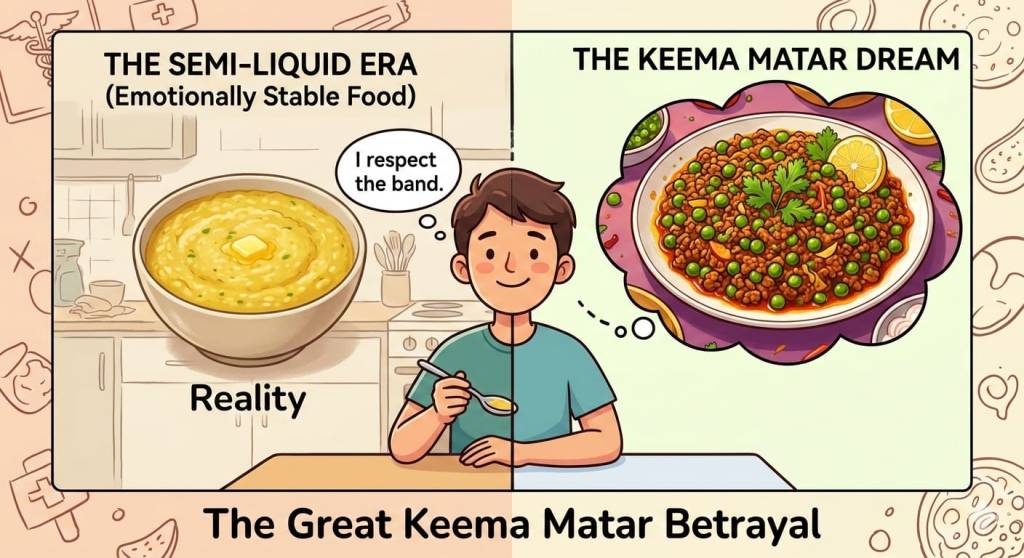
  • The Great Keema Matar Betrayal

    So here’s me.

    48 hours ago, I was bravely surviving on liquids like some kind of spiritual detox influencer. Except this wasn’t wellness—this was post-endoplasty with one band installed. 🫠

    The doctor said:
    “Liquid diet for 48 hours.”

    Me: Fine. I am strong. I am resilient. I am basically soup now.

    Then came the magical words:
    “You can now start semi-liquids.”

    And suddenly I felt like I’d been upgraded from Economy to Premium Economy. Not business class. Relax.


    Naturally, my brain said:
    “Keema matar?” 😍

    My body said:
    “Sir. You have a band in your esophagus. Please behave.”

    Because apparently, semi-liquid does NOT mean:

    • Chunky minced meat
    • Peas with attitude
    • Full masala Bollywood drama

    It means:

    • Smooth.
    • Soft.
    • Emotionally stable food.

    Keema matar right now would be less “comfort food” and more “why are you like this?”


    What My Life Looks Like Now

    I’ve entered my:

    • Moong dal era
    • Thin khichdi phase
    • Blended soup personality
    • Mashed potato main character arc

    Everything must:

    • Glide.
    • Not fight back.
    • Not require chewing like it’s a jaw workout challenge.

    Even curd has to be “not too sour.”
    Even buttermilk must behave.
    Even oats have to humble themselves.


    Things I’m Avoiding Like Ex Texts

    • Spicy gravies
    • Fried food
    • Chunky meat
    • Citrus
    • Anything that says “let’s test this band.”

    Because right now, the goal is healing — not auditioning for “India’s Got Swallowing Problems.”


    Conclusion

    Am I dreaming about keema matar? Yes.
    Am I going to eat it? Not unless I want my doctor to personally unfollow me.

    For now, I am one with Dal.
    I am spiritually aligned with khichdi.
    I respect the band.

    And one day… we shall reunite, dear Keema.

    But today is not that day. 😌

    ***Keema Matar – Succulent spiced minced meat slow-simmered with sweet green peas in a rich, aromatic masala that melts in your mouth and leaves you craving the next bite. 🔥🍽️

  • The Banquet of Fifty-One Selves

    Last night there were fifty of me at the table.

    Tonight, there is one more chair.

    It doesn’t scrape loudly across the floor like it did in the younger years. It doesn’t arrive late, breathless with ambition or drunk on certainty. It is placed carefully. Intentionally. As if it understands the weight of wood and memory.

    Fifty-One knocks before entering.

    He doesn’t look older in the way I feared. He looks clearer.

    His hair is thinner, yes. His stride is slower. But there’s something clenched about him. A quiet economy in the way he moves—as if he’s stopped spending energy proving and started investing it in preserving.

    The younger selves are still around, though quieter now.

    Twenty-One is mid-sentence about changing the world.
    Thirty is calculating risk.
    Forty-Five is tired but pretending not to be.
    Fifty is proud he survived the storms he never saw coming.

    But Fifty-One doesn’t compete for airtime.

    He listens.

    He studies Twenty-One with something like affection instead of embarrassment. He nods at Thirty-Six’s exhaustion. He puts a steady hand on Forty-Nine’s shoulder—the one that carries invisible ledgers of regret.

    Then he turns to me.

    “Have you noticed,” he asks gently, “that none of them were wrong? They were just incomplete.”

    The room shifts.

    Twenty-One wasn’t foolish—he was fuel.
    Thirty wasn’t anxious—he was building scaffolding.
    Forty wasn’t failing—he was learning the cost of endurance.
    Fifty wasn’t fading—he was refining.

    Fifty-One pours coffee instead of whiskey.

    The conversation changes.

    We don’t argue about what could have been. We talk about what still can be—without the desperation of legacy or the panic of expiration. The horizon no longer feels like a finish line. It feels like open country.

    He speaks of strength differently.

    Not the loud kind that breaks doors down.
    The quiet kind that keeps showing up.
    Pays the bills.
    Apologizes first.
    Forgives faster.
    Sleeps when needed.
    Laughs when possible.

    He isn’t obsessed with becoming more.

    He is interested in becoming true.

    The banquet table feels shorter now—not because there are fewer years behind me, but because the distance between them has softened. The sharp edges have worn down from handling.

    Five still builds forts under the table.
    Eight still wants to see the stars.
    Twenty-One still believes in impossible things.

    And Fifty-One?

    He makes space for all of them.

    He understands something the others didn’t:

    The goal was never to outrun time.
    It was to integrate it.

    When the candles burn low, he doesn’t fade back into my skin like the others did.

    He stays seated.

    Because Fifty-One isn’t a memory.

    He’s a decision.

    A decision to carry ambition without arrogance.
    To hold nostalgia without living inside it.
    To accept limitation without surrendering curiosity.
    To measure wealth in steadiness, not applause.

    Before the night ends, he slides something across the table.

    It’s not a map.

    It’s a mirror.

    And for the first time, I don’t see what’s missing.

    I see what’s assembled.

    The boy.
    The fighter.
    The provider.
    The doubter.
    The survivor.

    All present. All accounted for.

    Fifty-One lifts his cup.

    “We’re not done,” he says. “We’re distilled.”

    Outside, the house is quiet. Not empty—just grounded. The air smells less like urgency now and more like rain-soaked earth before something grows.

    I clear the plates more slowly tonight.

    No hurry.

    Fifty-Two will come when he’s ready.

    And when he does, there will be a chair waiting—already warm.

    Midlife #Turning51 #PersonalGrowth #AgingWell #MasculineJourney #SelfReflection #LifeAfter50

  • The 0.1% Void: Why Success Doesn’t Always Feel Like Victory

    We spend our lives building a blueprint. We map out the career, the city, the milestones, and the material acquisitions. We are told that once we reach the “Golden Gate” of our ambitions, the view will be worth the climb.
    But lately, I’ve been reflecting on a question that haunts many of us who have checked all the boxes: Why does it feel like something is still missing?

    The Paradox of Achievement
    According to the plan, I should be happy. On paper, everything is perfect. I have achieved the things I set out to do, yet there is a weight—a 0.1% void—that remains unfilled. It is the realization that the “end” we were running toward is often just a starting line for a new, more exhausting race.

    As the poetry of Ghalib reminds us, “Hazaaron khwahishein aisi ki, har khwahish pe dum nikle. (Desires are aplenty and each worth dying for.)” We fulfill many, yet we wake up hungry for more. This is the “marathon” of the modern world. We run blindly, convinced that the next promotion, the next car, or the next upgrade will be the one to finally grant us peace.

    The Problem: Running Blind
    The struggle isn’t the race itself; it’s the pace and the direction. When we run blindly, we lose our “situational awareness” in life.

    • The Comparison Trap: We stop valuing what we have because we are too busy coveting what others possess.
    • The Speed Fallacy: We move so fast that we miss the very life we are trying to improve.

    As the Nobel laureate Albert Schweitzer famously said, “Success is not the key to happiness; happiness is the key to success.” We’ve spent years reversing that equation, and we are paying for it with our internal peace.

    The Solution: Choosing Your Race
    Life will always be a race. Whether you are climbing the corporate ladder or building your own business, the pressure is constant. However, the solution isn’t to stop running—it’s to run with intention.

    • Audit Your Desires: Distinguish between what you actually want and what you’ve been conditioned to want.
    • Define Your ‘Enough’: If the goalpost is always moving, you will never feel like you’ve arrived. Define what “sufficiency” looks like for you.
    • Check the Clarity of the Faces Around You: This is my most vital takeaway. If you are running so fast that the faces of your family and friends are becoming a blur, you are running too fast. No trophy is worth losing the connection to the people you are supposedly running for.

    Closing Thoughts
    We often lose what we have in the pursuit of what we want. The struggle is real, but the solution is a shift in perspective. Let’s stop waiting for the “perfect moment” of happiness at the finish line and start finding it in the stride.
    The race won’t end until we do. The goal is to make sure that when we look back, we didn’t just see a blur of milestones but a gallery of faces and moments that truly mattered.

    #SuccessMindset #WorkLifeBalance #Leadership #MentalHealthAtWork #Perspective #LifeLessons #Grateful #SlowDown #InnerPeace #Mindfulness #Growth #Happiness #LifeQuotes

  • Stop Waiting: Express What Matters Today

    In my professional life, I deal with data, strategy, and “the next big thing.” But lately, I’ve been reflecting on a different kind of currency: the unspoken word. We often live our lives under the illusion of infinite time. We tell ourselves that we’ll call home tomorrow, that we’ll express our gratitude next week, or that we’ll finally tell someone how much they mean to us once the “perfect moment” arrives. But as I watched a series of reflections today on the heavy toll of silence, I was struck by a sobering truth: Regret doesn’t come from what we did; it almost always comes from what we failed to say.

    The Human Paradox: Proximity vs. Presence
    There is a strange phenomenon in human psychology. When people are with us, we become complacent. We assume their presence is a permanent fixture, and in that comfort, we forget to communicate the very things that make the relationship meaningful.
    The struggle is real. We are:

    • Distracted by the Trivial: We spend hours discussing politics, work, or the weather, yet shy away from five minutes of emotional honesty.
    • Paralyzed by Vulnerability: We hesitate to say “I love you” or “I’m sorry” because we fear the exposure.
    • The “Later” Fallacy: We treat time as an unlimited resource, unaware that the “last time” we speak to someone rarely announces itself in advance.

    The Solution: Closing the Communication Gap
    If the problem is a “delay in realization,” then the solution must be intentional immediacy. To move from a life of “I should have said” to “I’m glad I did,” we need a shift in perspective.

    1. Practice Radical Honesty in the Present
      Don’t wait for a milestone—a birthday, an anniversary, or a crisis—to express value. If you appreciate someone’s contribution at work or their presence in your life, tell them today. Professionalism doesn’t mean being robotic; it means being clear and authentic.
    2. Audit Your “Unfinished Business”
      Think about the people you haven’t spoken to properly in a while. Is there a missed call you haven’t returned? A “thank you” you’ve been meaning to send? Don’t let those small debts of gratitude accumulate interest until they become a burden of regret.
    3. Overcome the Hesitation
      The video noted that humans often say what they feel to everyone except the person involved. Break that cycle. If the sentiment is stuck in your heart, let it out through your voice. Vulnerability is not a weakness; it is the highest form of courage.

    My Final Thought
    The most haunting line I heard today was “I am always late.” Whether it’s a promise to keep or a person to call back, let’s stop being late.
    Life’s most complex problems often have the simplest solutions. We don’t need more time; we need more presence. We don’t need better words; we just need to say the ones we already have.
    Don’t leave your best words for a eulogy. Say them now.

    #Leadership #EmotionalIntelligence #Mindfulness #ProfessionalGrowth #LifeReflections #NoRegrets #DeepTalks #PerspectiveShift #Perspective #GrowthMindset #LifeLessons #PersonalGrowth #Relationships #DailyWisdom

  • The Weight We Carry: Finding Light in the Shadows of Ambition

    We’ve all been there. It’s 3:00 AM; the world is silent, but your mind is a stadium of noise. You’re staring at the ceiling, the sheets are damp from a cold sweat, and that familiar, gnawing companion—anxiety—is sitting heavy on your chest.

    In a world that demands constant “hustle,” we often forget the human cost of our ambitions. I recently found myself reflecting on this through a series of poignant moments—some from my own life, others mirrored in the stories we see every day. These moments reveal a universal truth: behind every professional facade, there is often a soul wrestling with the “imaginary ghosts” of failure and expectation.

    The Silent Struggle: When the Day Won’t End

    For many of us, the problem isn’t just the work; it’s the aftermath. We carry the day’s interactions, the missed deadlines, and the perceived disappointments into our beds. As the video I recently watched captured so perfectly:

    “Banda na kabhi kabhi bada majboor ho jata hai” (Sometimes, a person becomes truly helpless).
    This helplessness stems from a deep-seated fear of letting people down. We feel the weight of the trust others have placed in us, and when we stumble, we don’t just see a mistake—we see shattered hopes. We feel like we are “someone else” on the inside, while the outside world only sees the struggle.

    The Mirage of “Some Day”
    One of the most dangerous traps we fall into is the “Wait for Happiness.” We tell ourselves:

    • “I’ll be happy when I get that promotion.”
    • “Everything will be alright once I have enough money.”
    • “A new life is just one breakthrough away.”

    But as I’ve learned, life isn’t a destination; it’s the very grit and sand we are walking through right now. We often mistake the mirage for water, chasing a future version of ourselves while the present version is suffocating under the weight of “someday.”

    Redefining the Solution: Facing the Ghosts

    If the struggle is universal, the solution must be intentional. Here is how I am choosing to navigate these shadows:

    • Acknowledge the Interior: We spend so much time polishing the “gold of the heart” for others to see, but who is looking after what lies within? Mental health isn’t a luxury; it’s the foundation. Acknowledging that you are struggling isn’t a sign of weakness—it’s the first step toward reclaiming your peace.
    • Release the Weight of Expectations: You cannot pour from an empty cup. While responsibility is a virtue, carrying the weight of everyone’s expectations is a recipe for burnout. It is okay to be human. It is okay to fail.
    • Living with Vigor, Not Fear: There is a powerful line that stays with me: “Umar bhar khayali bhooto se agar main na darrta…” (Had I not feared imaginary ghosts all my life…). Most of what we worry about—the “ghosts” of what might happen—never actually occurs.

    Final Thoughts

    When we reach the end of our journey and look back, we won’t wish we had worked more hours or satisfied more critics. We will wish we had lived with more vigor and died with more peace.
    Don’t wait for your life to “flash before your eyes” to realize you were allowed to be happy today. The problems of life are real, but so is your capacity to face them.

    Let’s stop fearing the ghosts and start living the life we actually have.