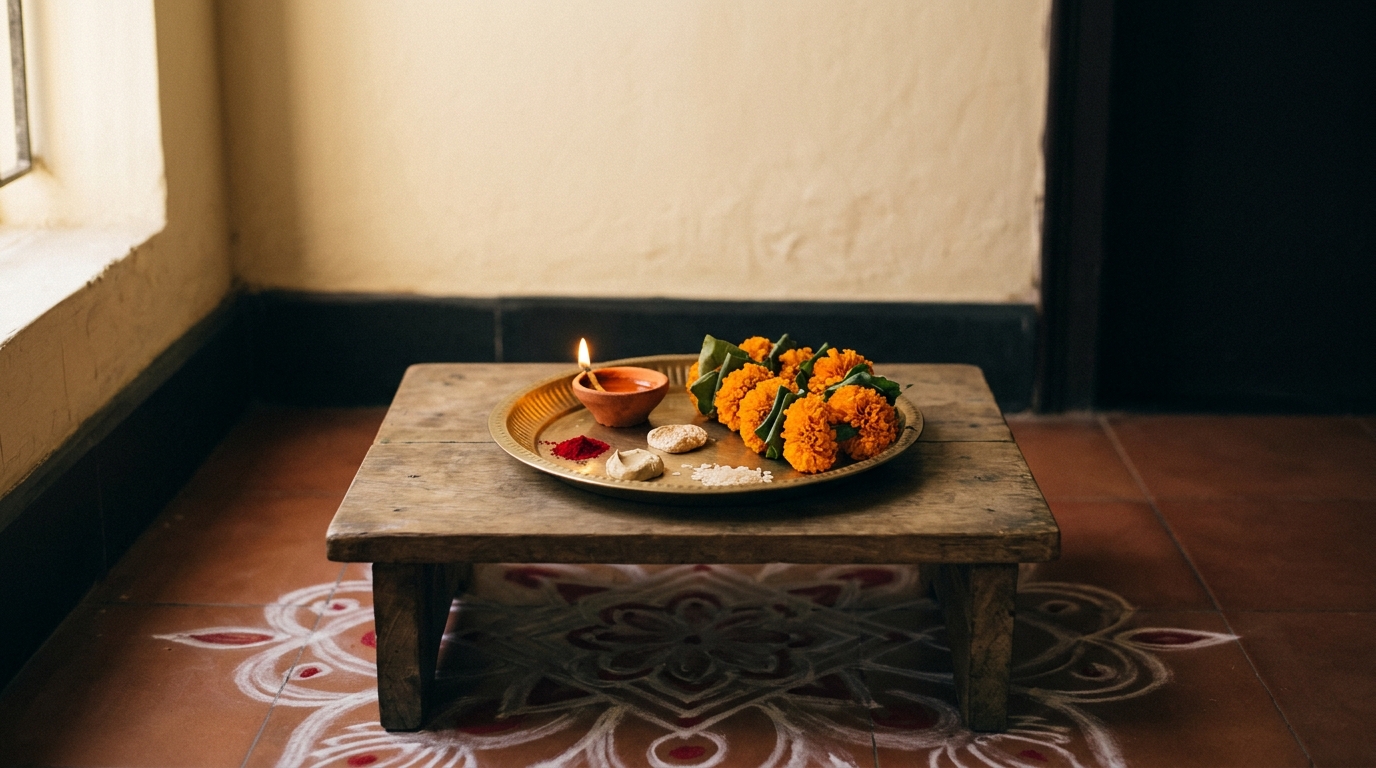
Diwali ends quietly. The lamps burn lower, the sweet boxes are half empty, the rangoli has been stepped on and smudged. And then, on the second day after the new moon, comes Bhai Dooj, the festival that closes the season not with fireworks but with a plate, a small flame and a mark on the forehead.
I have come to think this is deliberate. After days of wealth, light and spectacle, the calendar turns to the smallest unit of belonging: two people who share the same beginning.
The oldest promise
The story most of us know is simple. Yamuna invites her brother Yama, the god of death, to her home. He is the busiest being in creation and has never had time. She applies a tilak, feeds him, and he is so moved that he declares any brother who receives this welcome from his sister on this day will be protected. That is why the day is also called Yama Dwitiya.
Think about what is actually being said. Death himself, the one figure who is never late and never excused, takes a day off because his sister asked him to eat at her house. The myth makes a quiet claim: that love expressed through something as ordinary as hospitality has weight even against the cosmos.
Four kitchens, four ways of saying the same thing
What I love most about Bhai Dooj is that no two regions agree on how to do it, and all of them are right.
In Bengal, it is Bhai Phonta. The sister fasts until the ritual is done. With the little finger of her left hand, she dabs sandalwood, kajal and curd on her brother's forehead: peace, protection from the evil eye, and sweetness. As she does it, she recites a rhyme which, in plain words, says she is putting a thorn in the path of Yama, closing the gates of death to her brother. The folk story behind it has Yamuna easing her cursed brother's pain with sandalwood and prayer. Whatever its origin, the rhyme is magnificent: a sister, with a tiny dot of paste, defying mortality.
In Maharashtra, Goa and Karnataka, it is Bhau Beej. The brother sits on a low wooden stool, rangoli drawn around his feet, treated for a day as an honoured guest. In many homes, he first crushes a small bitter fruit, the karanda, underfoot. The fruit stands in for Narakasura, for pride and ego, and the custom echoes Krishna arriving at Subhadra's door after defeating the demon. The lesson is almost comic in its clarity: before you receive love, leave your ego at the door. Then comes basundi and hot puris, because humility goes down better with something sweet.
In Andhra Pradesh and Telangana, it is Bhagini Hasta Bhojanam, "the meal from the sister's hands." No elaborate symbolism is needed. A banana leaf, a meal cooked by a sister, a brother who made the journey to eat it. The tradition understands something we are in danger of forgetting: that food made with love is not merely food.
In Nepal, as Bhai Tika, the last day of Tihar, the tilak is made of seven colours, and the sister places a garland of makhamali flowers around her brother's neck. Folklore says a sister once bargained with Yamaraj himself: take my brother only when this oil line dries and this garland fades. But makhamali does not fade, and the oil held, and death left empty-handed. Whether you take it literally or not, the image stays with you: a love that insists on lasting.
What these rituals share
Look past the differences and a pattern appears. In every one of them, someone makes an effort for someone else. A sister fasts, cooks, draws, threads flowers, waits. A brother travels, sits, bows his pride, listens. Nothing about it is efficient. That is exactly the point.
Why this matters now
We live in the most connected era in history and, by many accounts, one of its loneliest. Families are smaller. Siblings live in different cities, different countries, different time zones. The relationship that once ran on shared rooms and shared meals now runs on a family WhatsApp group that goes silent for months and then explodes on a birthday.
I understand this from the inside. When you leave home for another country, as so many of us have, you learn that distance does not break a bond so much as put it on a schedule. The calls become planned. The festivals become a video screen. A tilak arrives, if at all, as a courier parcel of roli and rakhi, or a sister draws it in the air toward a phone camera and a brother bows his head to a glass rectangle.
And it still works. That is the surprising thing. Even through a screen, the ritual does what it was built to do: it forces a pause. It says, for ten minutes, nothing else matters more than this person. In an economy that bills us for our attention, giving it away freely to someone is a small act of rebellion.
The festival is also changing in healthy ways. Sisters who earn, protect, and carry their families now tie the thread to brothers who cook, listen and show up. Some celebrate with sisters, with cousins, with friends who became family. Some have no sibling at all and mark the day with a chosen one. The old Maharashtrian custom, in which a woman without a brother performs the rite toward the moon, always knew this: the bond is the point, and blood is only one way in.
What siblings really are
Parents shape us. Friends choose us. Partners join us midway. But siblings are the only people who remember who you were before you became who you are. They knew you at your most ridiculous. They hold the footnotes of your childhood, the nicknames, the old house, the smell of a particular kitchen. They are witnesses to your becoming.
Which is why a sibling's love is rarely loud. It is the call that comes when something goes wrong, no questions asked. It is the person who can say "you're being unreasonable" and still be forgiven by morning. It is one of the few relationships we do not have to earn by performing.
If there is a grievance between you and a sibling right now, an old argument, a silence that has hardened, a message left on "seen," Bhai Dooj is a gentle excuse to be the first to move. You do not need an apology speech. A plate, a call, a simple "come over" is the entire ritual.
For my brothers and sisters
To my sisters: thank you for the fasting, the cooking, the remembering. For being the ones who hold the family's memory together and who, for all the teasing, pray harder for us than we deserve. May the thorn you place in death's path every year find no gap to slip through. May you be as fiercely looked after as you look after others.
To my brothers: may we remember what the karanda is for. May we be the kind of men who come when called, who leave our pride at the door, who protect not by dominating but by showing up. May we be worthy of the tilak.
To siblings by blood, by choice, by circumstance, near or far, speaking or silent: may your thread not fray. May the distance between your cities never become the distance between your hearts. May there always be a plate set for you somewhere, a lamp lit in your name, and someone who still calls you by the name only they use.
And to everyone who is celebrating alone tonight, or carrying someone's memory instead of their company: you are held in this too. Love does not stop at the edge of a table. Light a small lamp, say a name aloud, and know the bond is still tied.
Happy Bhai Dooj.
May the garland never fade, and may the gates stay closed to every sorrow that dares to approach.
Loading comments…