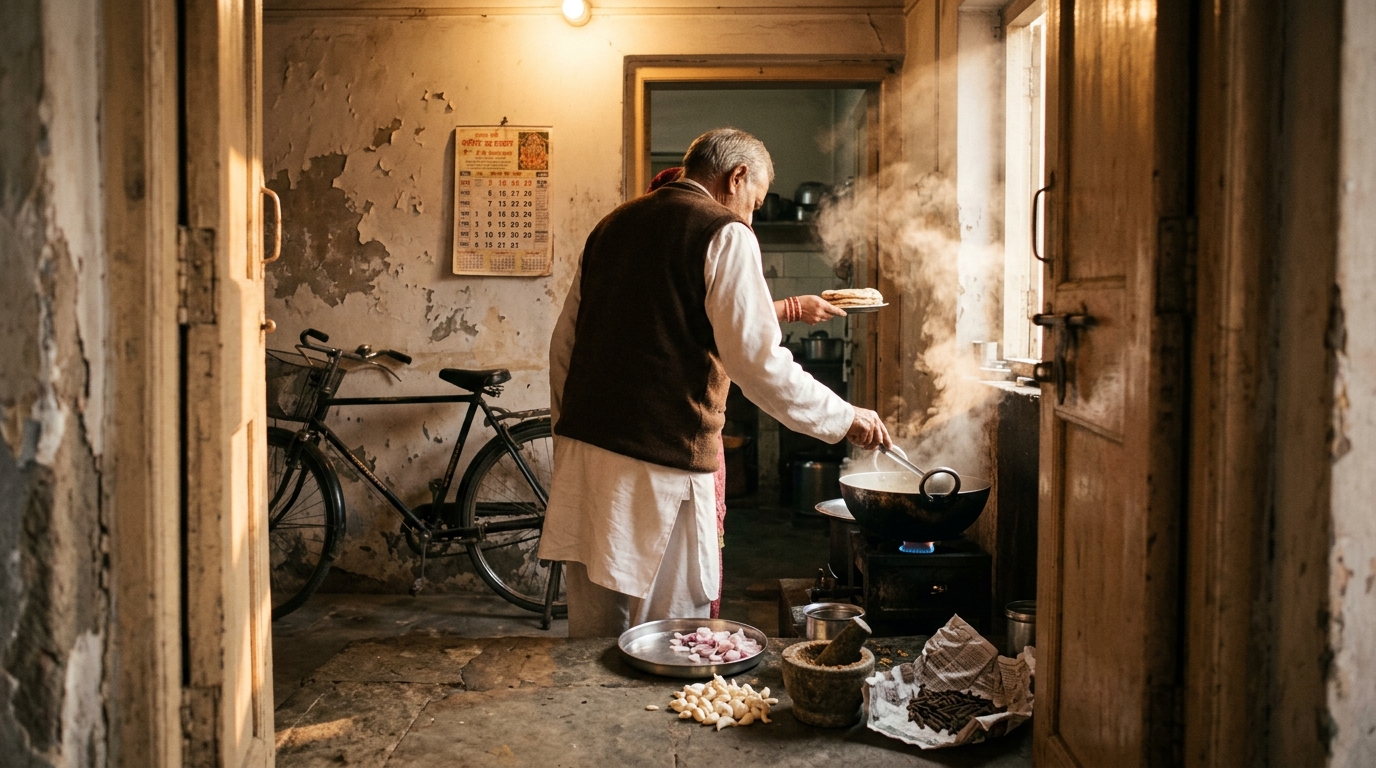
I lived with my grandparents in Model Town, Delhi. That was a long time ago, and I am writing this from memory, forty-five years on. Some things have gone soft at the edges. Others are as sharp as the day they happened.
My grandfather went everywhere on an old-school Hero bicycle. It was his regular, daily commute, and I can still see it leaning in the house.
My grandmother was a hardcore vegetarian, and she did not hide her feelings about meat. Her help on mutton days was limited. She cooked the chapatis and passed the plate out to wherever my grandfather was cooking, because the mutton never got made in her kitchen. It was made in a small, cramped portico inside the house, on a kerosene stove.
That is where my grandfather cooked his special mutton.
The meat came from one shop in Kamla Nagar, never more than three or four hundred grams, brought home specially. The whole spices came from Ghanta Ghar Market, wrapped in a newspaper pouch. There was a kerosene stove, a pateeli, and one kadchi of desi ghee. My grandmother sliced the onions. I was the commi. I peeled lots of garlic and crushed it in the mortar and pestle, and I crushed the whole spices too.
The pateeli went on the stove first, and the desi ghee went in after it. One full kadchi, never less. He let it warm slowly, and when it was ready the sabut masala (whole spices) went in for the tadka: jeera (cumin), tej patta (bay leaf), badi and chhoti elaichi (black and green cardamom), laung (cloves), a piece of dalchini (cinnamon). The ones I had crushed for him in the khal-batta. And with them the pipli (long pepper). Nobody else in that house knew what to make of that smell. To me it was simply the smell of mutton day.
Then came the ganda (onions) that my grandmother had sliced, and the thom (garlic) I had peeled and pounded until my fingers carried the smell for the rest of the evening. All of it went in together, and he left it on a dhimi aanch (slow flame), stirring now and then, in no hurry at all. There was no tamatar (tomato), no adrak (ginger), no sarson da tel (mustard oil). Only patience. The ganda had to go deep golden, almost the colour of old wood, and by then the whole portico was full of it.
A little lal mirch (red chilli) and namak (salt), a splash of pani (water) if the masala began to catch, and then the gosht (mutton). After that came the bhunaai (the slow roasting), turning the gosht again and again until the colour deepened and the ghee, the thom and the pipli had gone right into every piece.
Then a little hot pani, the heavy dhakkan (lid) pressed on tight, and the aanch kept low. He never hurried it, and he never let anyone lift the dhakkan to look. Somewhere in that waiting the gosht turned soft and the ganda melted into a dark, thick tarri (gravy). At the very end he took the dhakkan off and let the pani dry away until the ghee came back up and floated on top. That was how he knew it was ready. A pinch of garam masala, some hara dhania (fresh coriander), and it was done.
And all this while, phulke (chapatis) kept coming through the door, passed out by the one person in the house who would never touch the dish.
I can still remember the taste of that dish from then. The pateeli on the kerosene stove, ghee and pipli drifting out of the portico, my grandfather stirring with that kadchi, and garlic on my fingers for the rest of the evening. I have tried to make that mutton myself, but I have never been able to get the taste anywhere near it.
I don't know whether it is the taste, or the feeling, or the memory, or rather the love. My grandfather's love for me, and mine for him. Maybe that was the real masala, and it never came in a newspaper pouch from Ghanta Ghar.
And suddenly I can think of telling another one of his memories.
Probably next time.
But first, I have to go and buy some mutton and pipli.
Loading comments…