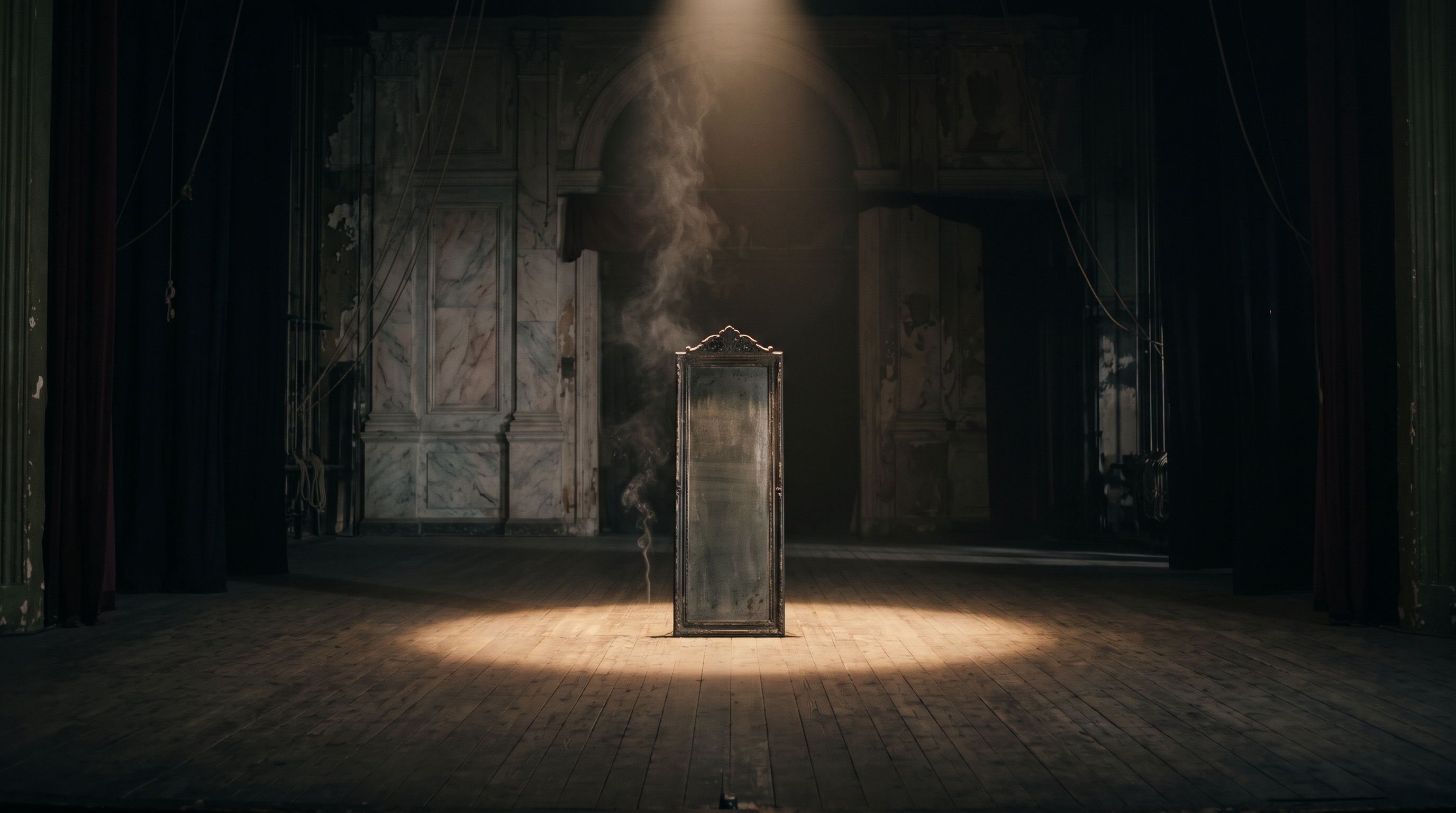
The stage is completely silent. There is no applause, no murmur of conversation, no turning of pages. Only the quiet, rhythmic hum of old memories breathing against the glass of the present.
Act I: The Echo in the Mirror
They tell you that time is a river, flowing ever forward, carving new paths through stone. But they have never stood still long enough to watch the silt settle.
I look at my hands today. They are steady, mostly, and they carry the quiet weight of mornings in Jumeirah, the routine turning of keys in ignitions, and the familiar hum of a city that never pauses to ask why. Yet beneath the surface of this ordinary present, an entire archive is playing on an endless loop. The past is not a ghost locked in an attic; it is the ink with which every current moment is written.
I see the boy born under a Delhi evening sky, decades ago, learning the cadence of the world before he knew how to name it. I trace the 19-year arc of crossing seas, planting roots in desert sand, building offices, homes, and identities out of sheer willpower and whispered prayers. Every street corner in this city holds a phantom footprint: a version of myself who walked it five years ago, ten years ago, carrying different dreams, different sorrows, and the same quiet hunger for meaning.
We spend our lives narrating our stories, don't we? We polish the sentences, edit out the clumsy pauses, and rehearse the triumphant chapters so we can present them to the world like neatly wrapped gifts.
Act II: Speaking to the Silence
And then I turn around to share it. And I look at you.
An audience that is dumb and deaf.
You sit before me in absolute, unyielding stillness. Your ears do not catch the tremor in my voice; your lips do not part to offer a critique, a question, or even a sigh of agreement. I can lay bare the most intricate architecture of my regrets, the subtle epiphanies born from late-night solitude, and the exact texture of nostalgia that clings to an old song, and it hits your presence like wind against a stone wall.
There is a strange, profound liberation in performing for those who cannot hear.
When no one can speak back, you stop shouting to be understood. The performance strips away its vanity. I don't need you to validate the sorrow or applaud the resilience, because your silence forces the monologue to turn inward. If you cannot hear my words, then I am left with only one choice: to listen to them myself.
Perhaps that is why we are given such an audience by the universe. We think we are standing on a stage, trying to reach the world, when, in truth, the universe has simply placed a mirror in front of us. You, the silent crowd, are just the quiet space I needed in order to finally hear my own soul speak.
Act III: The Unspoken Symphony
So I keep narrating.
Not because you will clap. Not because you will lean forward and say, "I understand."
I narrate because the act of remembering keeps the blood moving. I tell the story of the past to this silent room because every word spoken into the void leaves a residue on the present, turning raw survival into art. The fire burns, the smoke rises into the indifferent air, and the silence receives it all without judgement.
And in that absolute stillness, the narrative completes itself.
Safed sang ki chadar lapet kar mujh par, Faseel-e-shahar pe kis ne saja diya mujhko...
Epilogue: The Marble and the Dust
Those lines have followed me for years, and I understand them better now that I have spoken to an empty room.
Someone wraps you in a sheet of white stone and sets you high on the city wall. From below it looks like honour. It looks like an arrival. But I know how that goes: you are placed there, admired from a distance, and nothing in the wrapping asks what was inside it. Marble is what the world gives you when it has decided to stop listening.
I have climbed out of the dust more than once. I have been the small speck reaching for some version of greatness, and I have carried the endless, grinding pursuit of bread and dignity that every immigrant knows in the body before he can say it in words. I have stood before the towering stacks of books, degrees and philosophies and asked them, quietly, what they gave me when the night grew cold. They did not answer. Like my audience, they were deaf and dumb.
And here is the quiet realization, the one I could only reach in silence: the most relentless adversary I have ever faced was never out there in the crowd. It was breathing right beneath my own ribs. The one who lit the fire and the one who tried to put it out were, for a long time, the same person.
The curtain falls. The marble sheet is drawn over the quiet city wall. And still the smoke rises, carrying the truth of a fire that refused to be extinguished quietly:
Dhuaan bana ke fiza mein udaa diya mujhko, Main jal raha tha, kisi ne bujha diya mujhko...
Loading comments…